Outsourced IT services in 2026 generally cost between $80 and $500 per user per month, with some comprehensive solutions exceeding $1,000 per user. For hourly pricing, managed service providers (MSPs) charge between $75 and $250 per hour, with rates influenced by their expertise, experience, and geographic location. These costs can fluctuate based on the complexity of the services and the capabilities of the IT service provider.
Various pricing models influence the outsourced IT cost, including hourly, per user, flat-rate, and retainer options. SLAs, location, compliance needs, and the complexity of the technology stack also impact the total outsourcing expenses. To manage and reduce these costs, businesses can leverage strategies like vendor negotiation, adopting hybrid staffing models, and conducting regular audits.
By understanding how outsourced IT services are priced, SMBs and larger businesses can effectively scale their IT support while avoiding unnecessary expenses. Through careful cost modeling, they can ensure better budget management, clearer billing practices, and consistent service quality through efficient resource allocation.
What Are the Costs of Different Types of Outsourced IT Services?
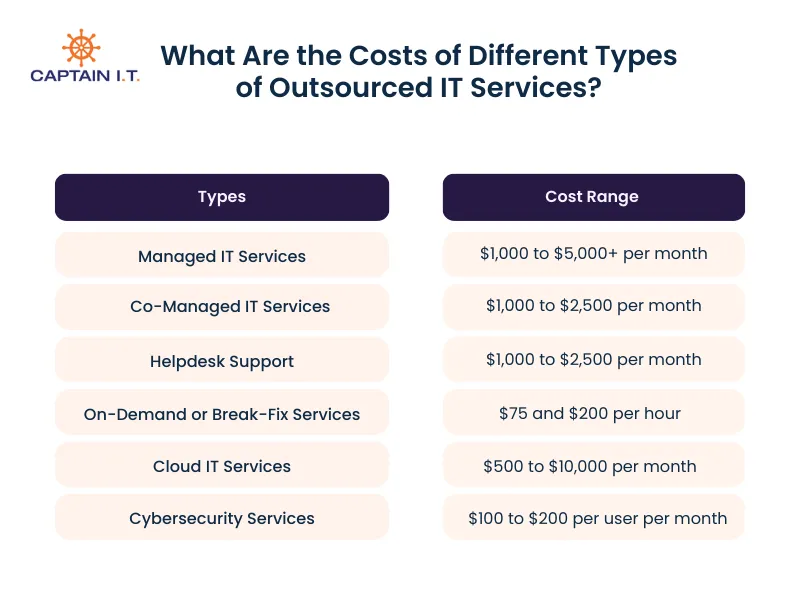
Different types of outsourced IT services cost between $75 to $250 per hour or up to $10,000 per month for SMBs, depending on the service type, scope, and complexity. This range covers various services including managed IT, co-managed IT, help desk support, on-demand services, cloud IT, and cybersecurity, with costs varying based on the level of expertise, number of users, and the specific needs of the business.
What Is the Cost of Managed IT Services?
Managed IT Services typically cost $100 to $250 per user per month, or between $1,000 and $5,000+ per month for overall services. These services may include network monitoring, security, troubleshooting, and helpdesk support, and the cost can vary based on the size of the business, the scope of services, and the level of customization required. For small and medium-sized businesses (SMBs), this model offers a predictable, flat-rate expense for comprehensive IT support, helping them maintain control over IT needs without surprise costs.
How Much Do Co-Managed IT Services Cost?
Co-Managed IT Services typically cost $75 to $150 per hour or $1,000 to $2,500 per month, depending on the specific services provided. This model allows businesses to share IT responsibilities with an outsourced provider, often focusing on specific tasks like advanced troubleshooting or strategic oversight, while maintaining a high degree of internal control. It offers flexibility, as businesses only pay for the specific services they need, making it more affordable than fully managed IT services, especially for businesses that already have in-house IT teams but need additional expertise.
What Is the Cost of Helpdesk Support?
The cost of Helpdesk Support ranges from $75 to $150 per user per month for comprehensive services, including 24/7 support and priority handling, while per-incident pricing can range from $1 to $25 per ticket, depending on the complexity of the request. Outsourcing help desk support to regions like Southeast Asia or Eastern Europe can be more affordable, with typical pricing ranging from $20 to $50 per user per month. These regions offer lower labor costs, making them an attractive option for SMBs seeking more affordable IT support solutions.
How Much Do On-Demand or Break-Fix Services Cost?
On-Demand or Break-Fix Services cost between $75 and $200 per hour. This model allows businesses to pay only when issues arise, with rates depending on the urgency and complexity of the issue. While break-fix services offer flexibility, they can be less predictable and more expensive in the long run for businesses that experience frequent IT problems. This model is typically used by SMBs with occasional IT needs, but it can become costly if used regularly due to downtime and unpredictable service requirements.
What Is the Price of Cloud IT Services?
Cloud IT Services cost $500 to $10,000 per month when provided by Managed Service Providers (MSPs) for comprehensive services, including network management, data storage, security, backups, and disaster recovery. However, these services vary widely, with options as affordable as under $1 per month for the cheapest Google One subscription when paid annually. The flexibility of cloud services allows businesses to either subscribe on a monthly basis or pay for usage, offering scalability and cost-efficiency for both SMBs and larger enterprises.
How Much Do Cybersecurity Services Cost?
Cybersecurity Services typically range from $100 to $200 per user per month. The actual cost depends on the size of the business, the complexity of security needs, and the level of service required. For SMBs, basic network security and monitoring might cost around $100, while more comprehensive security services, such as threat monitoring, incident response, and compliance support (e.g., HIPAA or GDPR), can drive costs higher. Due to the ongoing risk management, 24/7 monitoring, and specialized expertise involved, cybersecurity services tend to be more expensive than some other IT services.
What Are the Pricing Models for Outsourced IT Services?
Outsourced IT providers offer hourly, per user, flat rate, tiered, and retainer pricing models that shape how organizations structure their payments. These models help companies match their operational needs with predictable, scalable, or flexible billing.

How Much Does Hourly Rate Pricing Cost?
Hourly rate pricing for outsourced IT services typically ranges from $75 to $250 per hour, depending on the expertise and complexity of the service. This model allows businesses to pay only for the hours worked, making it ideal for short-term or project-based work, though it can become unpredictable and more expensive for businesses with frequent IT needs.
How Much Does Per User Pricing Cost?
Per user pricing typically ranges from $100 to $250 per month. This model is popular among small and medium businesses that need consistent IT support, as it offers a predictable monthly cost with minimal hidden fees. For larger businesses or those with a greater number of users, bulk discounts are available to help reduce the per-user cost, making it more affordable as the number of users increases.
What Is the Cost of Flat-Rate Pricing?
Under flat-rate pricing, outsourced IT services cost between $5,000 and $7,000 per month, though it varies based on the number of employees and the scope of services. MSPs set different prices depending on business size. This model is ideal for both SMBs and larger businesses looking for budget certainty, as it offers a fixed monthly fee for comprehensive IT support, including network monitoring, troubleshooting, security, and maintenance.
How Much Do Tiered Pricing Models Cost?
The tiered pricing models cost $25 to $200+ per user per month. For instance, a basic tier may cost $25 to $100 per user for basic support and monitoring, standard tier may cost $100 to $200 for advanced support and enhanced monitoring, while premium tier may cost $200 or more for businesses needing specialized expertise or comprehensive solutions. This flexible model allows SMBs to choose a service level that fits their needs and budget, with the option to scale up or down.
What Does Retainer Pricing Cost?
Under retainer model, IT services cost $75 to $300 per hour, or $1,000 to $10,000 per month for SMBs, depending on the hours reserved and the level of expertise required. In this model, businesses pay a fixed fee to retain dedicated IT support for a set number of hours or services each month. It is ideal for businesses with ongoing IT support needs like system updates, maintenance, and regular troubleshooting. The retainer model offers SMBs guaranteed availability and prioritized support, ensuring that IT tasks are handled efficiently as they arise.
What Are the Factors that Influence the Cost of Outsourced IT Services?
The cost of outsourced IT services is influenced by geographic location, service level agreements (SLAs), project complexity, team size, and the level of customization required. These variables affect operational risks, vendor staffing needs, and the level of expertise needed to meet specific business requirements.
What Is the Impact of Geographic Location on Outsourced IT Costs?
Geographic location significantly influences outsourcing costs, as labor rates differ across regions. Providers in high-cost regions, like North America or Western Europe, typically charge more for the same tasks than teams in countries with lower wages. Organizations tend to evaluate regional pricing to balance service quality, talent availability, and overall expense when selecting an outsourcing partner. According to DistantJob research, the average IT costs around the world are as follows:
| Regions | Countries | Hourly Range |
| Southeast Asia | Indonesia, Philippines, Vietnam, India, Pakistan, Bangladesh | $20 to $40 |
| Latin America | Mexico, Argentina, Brazil, Colombia, Peru | $25 to $50 |
| Eastern Europe | Ukraine, Romania, Poland, Hungary, Czech Republic | $25 to $50 |
| Africa | South Africa, Nigeria, Morocco, Egypt | $15 to $40 |
| North America, Europe & Australia | USA, Canada, UK, Germany, Netherlands, Australia, New Zealand | $50 to $200 |
How Do Service Level Agreements (SLAs) Affect IT Outsourcing Costs?
Service Level Agreements (SLAs) directly impact the cost of IT outsourcing by stating performance expectations such as uptime, response time, and issue resolution. Higher-tier SLAs, which demand faster response times or extended monitoring, increase costs due to additional resources required to meet these service commitments. For example, businesses requiring 24/7 support or rapid escalation may pay $1,500 per month instead of $500 for standard support, as MSPs need to maintain round-the-clock staffing and infrastructure to facilitate such support levels.
How Does the Complexity of an IT Project Influence Its Cost?
The complexity of an IT project increases costs because complex projects require more time, specialized expertise, and resources. For instance, custom software development might cost $15,000 to $100,000 depending on the project’s scope and complexity. This is because complex projects involve more intricate planning, skilled labor, and prolonged timelines. Additionally, projects like multi-cloud environments or AI/ML integrations require deeper technical knowledge, resulting in higher costs due to the specialized expertise needed to implement and maintain such systems.
How Do the Number of Users and Devices Impact IT Outsourcing Costs?
The number of users and devices directly affects IT outsourcing costs, as more users or devices require additional support, monitoring, maintenance, and infrastructure. For example, an enterprise with 1,000 employees may pay $150,000 per month in IT service costs, while an SMB with 100 employees might pay only around $15,000. However, larger businesses often benefit from volume discounts, which can reduce the per-user or per-device rate, although the overall cost will still be higher due to the increased number of users and devices that require continuous support.
How Does Customization and Specialization Affect IT Service Pricing?
When businesses need customized or specialized IT services, the costs are generally higher due to the time, expertise, and resources required. For instance, bespoke software development cost can range from $15,000 to $100,000 depending on the level of customization. Similarly, custom security configurations or enterprise-level solutions come at a premium because they require highly specialized skills and additional work to meet the business’s unique requirements. The more tailored the IT solution, the higher the cost due to the extra complexity and expertise involved.
How Do 24/7 Support Requirements Affect Outsourced IT Costs?
24/7 support requires continuous staffing and infrastructure to ensure uninterrupted service, which significantly increases costs. For example, an e-commerce business that operates across different time zones and relies on critical systems might pay an additional $20,000 per month for round-the-clock coverage. This higher cost stems from the need for additional staffing and infrastructure to manage service requirements across multiple time zones. It also requires more complex coordination between teams so that support remains available at all hours, ensuring uptime and handling customer inquiries across multiple regions.
How Does Vendor Experience and Reputation Influence IT Pricing?
Highly experienced vendors usually charge premium rates as they can justify their fees through a track record of offering higher-quality services, better risk management, and deeper understanding of industry-specific challenges. As a result, businesses often find it worth paying more for reliable vendors with a strong reputation and specialized knowledge. For example, an MSP with specialized cybersecurity expertise might charge $200 per user per month, while a less experienced provider charges just $100.
How Does the Cost of Outsourced IT Compare to In-House IT?
Outsourced IT services cost significantly lower than maintaining an in-house IT team because businesses can avoid the salary, benefit, and overhead expenditures associated with full-time employees. For example, businesses can avoid paying the annual wages for network architects and IT support specialists, which range from $61,550 to over $130,000 according to the Bureau of Labor Statistics. In addition to salaries, businesses can also avoid equipment, software, and ongoing training expenses by outsourcing their IT functions.
The table below shows further comparisons between outsourcing and maintaining an in-house IT team:
| Factor | Outsourced IT | In-House IT |
| Setup/Equipment Cost | Typically included in service fees | Requires upfront investment in infrastructure and equipment |
| Wages | Lower due to offshoring opportunities | Higher due to salaries, benefits, and recruitment costs |
| Employee Benefits | Not applicable, as there are no direct employees | May includes healthcare, retirement, and paid time off |
| Training Costs | Vendors handle their own training | Continuous training and certification costs for employees |
| Scalability | Highly flexible and scalable as needed | Limited scalability, requiring additional hires for growth |
| Control | Less direct control over operations | Full control and oversight of all IT operations and decisions |
| Regulatory Compliance | Risk of not managing regulatory requirements | More likely to comply with local regulations and avoid legal penalties |
What Are the Hidden Costs of Outsourced IT Services?
While outsourced IT services appear more cost-effective, there are hidden costs that businesses should consider, such as onboarding, training, integration, service-level agreement (SLA) penalties, and communication challenges. These hidden costs can significantly impact overall budgeting and may even outweigh the initial savings, leading to unforeseen expenses.
Hidden costs of outsourced IT services:
- Onboarding challenges: Time and resources spent integrating new teams or systems into your business.
- Training costs: Ongoing training needed to ensure your outsourced team understands your systems and processes.
- Integration costs: The expense and time required to integrate external IT services with your internal infrastructure.
- Communication gap: Differences in time zones and cultural barriers can reduce productivity, leading to delays and inefficiencies.
- Regulatory penalties: Non-compliance with industry regulations can lead to fines if the outsourced provider fails to meet necessary standards.
- SLA penalties: Costs incurred when an outsourced provider fails to meet agreed-upon service levels.
- Scope creep: Additional services or unanticipated needs arise during the project, leading to increased costs.
- Unpredictable changes: Sudden changes in technology or scope that increase the cost without prior planning.
- Third-party risks: Risks associated with subcontracting services to another provider, which could affect quality and timing.
How to Reduce Outsourced IT Costs?
To reduce outsourced IT costs, businesses should negotiate vendor contracts, use hybrid outsourcing models, take advantage of volume discounts, and commit to long-term deals after careful evaluation. These strategies, along with streamlining platforms and tools, can help businesses maintain service quality while cutting unnecessary expenses.
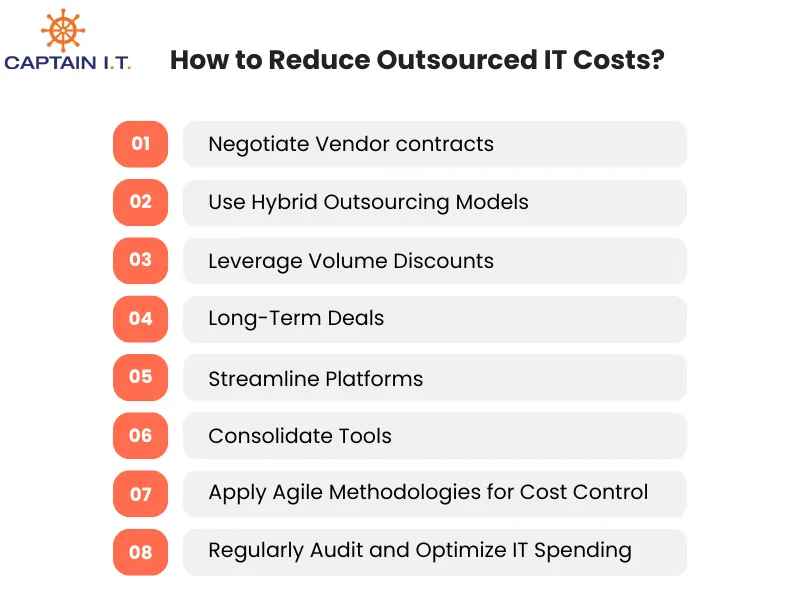
8 ways reduce outsourced it costs are:
- Negotiate Vendor contracts: Carefully reviewing the terms and negotiating can help secure lower rates, better service level agreements (SLAs), and prevent hidden fees. Regular contract reviews also allow for adjustments based on changing needs.
- Use Hybrid Outsourcing Models: Combining in-house and outsourced resources balances costs by allowing businesses to keep control over critical and strategic tasks while outsourcing routine work, optimizing resource allocation.
- Leverage Volume Discounts: When outsourcing large-scale projects with significant volume of work and high number of users, vendors may offer discounts that can lower per-unit costs by a large margin.
- Long-Term Deals: Committing to longer contracts can often result in lower pricing because vendors value long-term business. However, careful consideration and strategic planning is required, as it carries greater financial risk.
- Streamline Platforms: Reducing the number of platforms used for IT services can lower service and management costs. Simplifying platforms reduces complexity and operational expenses while making operations more efficient.
- Consolidate Tools: Using fewer tools for IT management, security, and monitoring can minimize redundant spending. Fewer tools mean simpler management, fewer licenses, and lower costs.
- Apply Agile Methodologies for Cost Control: Agile methodologies break work into smaller tasks that can be adjusted as needed, reducing waste by focusing on critical tasks and adapting to changes without incurring extra costs.
- Regularly Audit and Optimize IT Spending: Ongoing audits and regular reviews help eliminate unnecessary IT expenses and optimize resource use. It ensures that IT spending aligns with business needs and that underutilized services are addressed.
How to Choose the Right IT Outsourcing Partner for Cost Efficiency?
To choose an IT outsourcing partner for cost efficiency, look for MSP with transparent pricing, clear SLAs, monitoring capabilities, and suitable communication method based on their time zone. Cost efficiency is a primary goal in outsourcing, and the right MSP can help minimize expenses while maximizing service quality. Consider the following selection factors:
- Past Experience: Review case studies or testimonials that demonstrate the service provider’s ability to help clients reduce costs while meeting their business objectives.
- Transparent Pricing Model: A clear pricing structure with detailed cost breakdown helps avoid hidden costs and enables easier budgeting.
- Clear SLAs with Cost-Linked Penalties: SLAs that define performance metrics and include penalties for missed targets show accountability.
- Automation and Monitoring Tools: Automation tools and real-time monitoring reduce routine manual work and improve productivity.
- Scalable and Flexible Resources: The vendor should be able to scale resources as your business needs change, without increasing the costs significantly.
- Geo-location Impact (Offshore vs. Nearshore): The location of the provider impacts communication, issue resolution, and time zone alignment. Offshore providers often offer lower rates but may face challenges with time zone differences or communication delays, while nearshore providers may provide a balance of cost savings and better collaboration.
To verify these factors, request detailed quotes with cost breakdowns and conduct trials or simulations to assess service quality and performance. Trials or pilot projects allow you to assess the MSP’s service quality, responsiveness, and how well they meet the agreed-upon SLAs before committing to a full contract. By thoroughly evaluating these aspects, you can ensure that the IT outsourcing service provider aligns with your business objectives, budget, and operational requirements while minimizing risks and being prepared to scale up or down.