Managed IT Services and Co-Managed IT Services are two IT management models designed to support businesses with different levels of internal capability and control requirements. Managed IT Services operate as a full outsourcing arrangement in which a Managed Service Provider owns IT operations, including monitoring, security, help desk support, and ongoing maintenance, with clear SLA ownership and risk ownership assigned to the provider. Co-Managed IT Services follow a hybrid approach, combining internal IT resources with external support through shared responsibility and collaboration.
The core distinction between the two models lies in how IT ownership is distributed. Managed IT Services centralize accountability with the provider, making them suitable for organizations that want to offload IT execution entirely, including incident command and compliance responsibility. Co-Managed IT Services retain internal oversight of critical systems while using an MSP for gap filling, scalability, and specialized expertise, allowing businesses to stay involved in IT decisions without managing all operational tasks.
Selecting the right model depends on internal IT maturity, staffing, budget structure, and desired control. Businesses without internal IT teams often prefer the simplicity and predictability of managed IT, while organizations with existing IT staff benefit from the flexibility and shared control offered by co-managed IT.
What Are Managed IT Services?
Managed IT Services is the comprehensive IT support provided by a third-party service provider, known as a Managed Service Provider (MSP). Managed IT services are designed to handle a company’s IT infrastructure, offering everything from network management and cybersecurity to data backups and disaster recovery.
Businesses of all sizes, small businesses to manufacturers to healthcare providers can benefit from Managed IT Services. By outsourcing IT management, companies free up their resources, reduce the burden on internal teams, and gain benefit from specialized expertise and IT resources without hiring extra staff.
Proactive monitoring, security management, 24/7 support, and software patching is included in Managed IT Services. With these comprehensive IT services, businesses can grow with the confidence that their IT operations are secure, efficient, and scalable. An MSP helps businesses stay ahead by providing strategic guidance and a customized approach to IT solutions, enabling business continuity and a competitive edge.
What Are Co-Managed IT Services?
Co-Managed IT Services is a hybrid IT management model built on partnership and collaboration between an internal IT team and an external Managed Service Provider (MSP). Instead of fully offloading responsibility, the organization and the MSP operate under a shared responsibility framework, in which risk and SLA ownership, as well as escalation paths, are divided by defined roles. The MSP provides targeted support across security operations, monitoring, backups, cloud management, and help desk overflow. The model blends ongoing proactive services such as monitoring, patching, and risk mitigation with reactive support for incidents that exceed internal capacity, allowing responsibilities to be distributed based on expertise rather than fully outsourced.
Rather than replacing internal IT teams, co-managed IT services focus on filling gaps and extending capacity, while incident command and compliance responsibilities may remain internal or shared, depending on the governance design. This approach fits mid-sized organizations with lean in-house IT teams, healthcare providers managing compliance-heavy environments, manufacturing companies supporting production systems, and fast-growing businesses facing uneven or seasonal IT workloads. Through this collaborative arrangement, organizations offload specialized or time-intensive tasks, gain access to advanced tools and expertise, and maintain direct oversight of critical systems, while avoiding the cost structure and operational rigidity associated with full IT outsourcing.
Difference Between Managed IT Services and Co-Managed IT
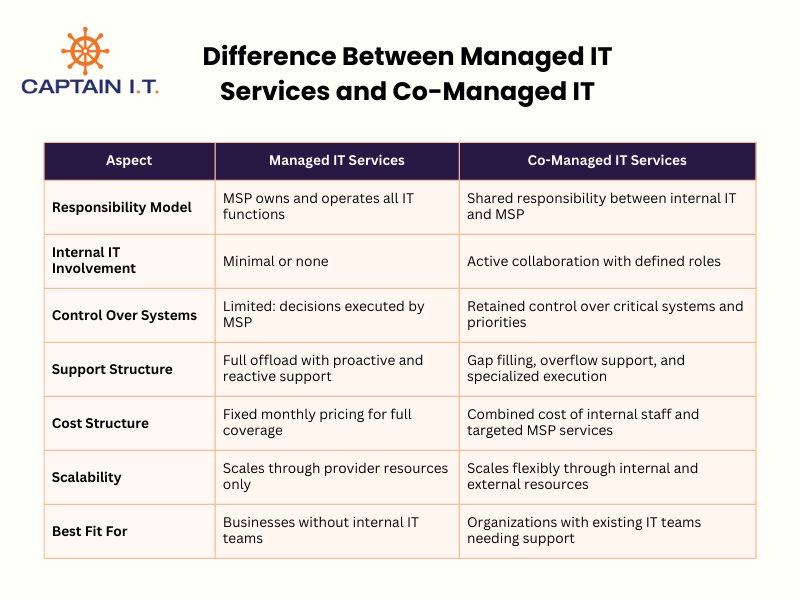
Managed IT services is a full outsourcing model in which the MSP owns and manages all IT operations, including SLA ownership, escalation paths, incident command, and risk ownership, whereas co-managed IT services is a shared IT management model in which these responsibilities are split between an internal IT team and an MSP. Managed IT focuses on centralized accountability, while co-managed IT emphasizes collaboration, shared control, and distributed responsibility.
The table below summarizes how managed and co-managed IT services differ across ownership, control, cost structure, and scalability, helping businesses quickly evaluate which model best aligns with their operational needs.
| Aspect | Managed IT Services | Co-Managed IT Services |
| Responsibility Model | MSP owns and operates all IT functions | Shared responsibility between internal IT and MSP |
| Internal IT Involvement | Minimal or none | Active collaboration with defined roles |
| Control Over Systems | Limited: decisions executed by MSP | Retained control over critical systems and priorities |
| Support Structure | Full offload with proactive and reactive support | Gap filling, overflow support, and specialized execution |
| Cost Structure | Fixed monthly pricing for full coverage | Combined cost of internal staff and targeted MSP services |
| Scalability | Scales through provider resources only | Scales flexibly through internal and external resources |
| Best Fit For | Businesses without internal IT teams | Organizations with existing IT teams needing support |
Pros of Managed IT Services
Managed IT services offer full IT offload, predictable monthly costs, centralized accountability, proactive monitoring, and reactive help desk support through a single Managed Service Provider. This model allows businesses to eliminate internal IT workload, rely on ongoing proactive maintenance and break-fix resolution, and maintain stable, secure systems without managing day-to-day IT operations internally.
7 core advantages of managed IT services for businesses are:
- Full Outsourcing of IT:
Under a managed IT services model, the MSP assumes ownership of all IT operations, including infrastructure, security, monitoring, and user support. This complete offload removes the burden of internal troubleshooting and system upkeep, allowing businesses to focus on core operations rather than managing IT operations.
- Predictable Costs:
One of the primary financial benefits of managed IT services is the use of fixed monthly pricing. This structure stabilizes IT spending by replacing unpredictable repair costs with planned operating expenses, helping businesses avoid unexpected charges for outages, emergency fixes, or equipment failures. In markets like Los Angeles, pricing commonly ranges from $150–$500 per server and $25–$150 per desktop, depending on scope.
- 24/7 Monitoring and Support:
Continuous system monitoring enables MSPs to track performance, availability, and security conditions at all times. By identifying issues early, managed IT services reduce downtime through proactive intervention rather than waiting for disruptions to impact business operations.
- Access to Expertise and Tools:
Through managed IT services, businesses gain direct access to specialized technical expertise and enterprise-grade tools without building these capabilities internally. MSPs maintain skilled teams across cybersecurity, cloud management, networking, and compliance, providing broader coverage than most in-house teams can sustain.
- Reduced Internal Staffing:
Shifting IT execution to an MSP decreases the need for full-time internal staff dedicated to routine support and maintenance. This allows organizations to lower payroll costs, reduce turnover risk, and reallocate internal resources to strategic initiatives rather than day-to-day IT administration.
- Improved Disaster Recovery:
Structured backup processes and tested recovery plans are standard components of managed IT services. These controls ensure faster data restoration and system recovery following incidents such as ransomware attacks, hardware failures, or outages, limiting operational disruption and data loss.
- Up-to-Date Technology:
Ongoing patching, system updates, and platform maintenance keep IT environments current and secure. Managed IT services ensure that vulnerabilities are addressed promptly and that systems operate efficiently, without requiring businesses to continuously track technological changes or emerging security threats.
Cons of Managed IT Services
While managed IT services offer significant advantages, they also involve reduced control over IT decisions, reliance on a single service provider, limited customization, and gradual loss of internal IT expertise. These trade-offs require businesses to weigh the benefits of full IT offload against their need for flexibility, internal oversight, and long-term IT governance.
4 key disadvantages of managed IT services include:
- Reduced Control Over IT Decisions:
With managed IT services, operational control shifts to the MSP, which can limit how quickly businesses influence technical decisions or customize processes. Organizations that prefer hands-on oversight may find this model restrictive, especially when internal preferences differ from standardized MSP practices.
- Dependence on a Single Provider:
Relying entirely on one MSP creates dependency for IT operations, security, and support. If service quality declines, response times slow, or the provider relationship changes, businesses may face disruption as they transition to a new provider or renegotiate service terms.
- Limited Customization for Unique Environments:
Managed IT services are often delivered through standardized service frameworks designed for efficiency and scale. While effective for many businesses, this structure may not fully align with organizations that require highly specialized workflows, niche applications, or non-standard infrastructure configurations.
- Less Internal IT Knowledge Development:
Over time, full IT offload can reduce internal technical knowledge and system familiarity. This may limit an organization’s ability to independently evaluate IT decisions, manage vendor relationships, or transition away from the MSP without a learning curve.
Pros of Co-Managed IT Services
Co-managed IT services integrate internal IT capabilities with external MSP resources, creating a hybrid management model. This setup enhances scalability, optimizes resource allocation, and supports adaptive IT governance aligned with organizational demands.
7 key advantages of co-managed IT services for organizations are:
- Shared Control and Retained Oversight:
Co-managed IT services allow organizations to maintain direct control over critical systems, architecture decisions, and priorities while sharing execution with an MSP. This structure supports internal governance and strategic alignment without forcing full IT ownership to be outsourced.
- Flexible Cost Management:
Rather than paying for full IT outsourcing, businesses only engage external support where gaps exist. This pay-for-need approach helps control costs by combining internal staffing with targeted MSP services, making co-managed IT financially efficient for organizations with partial IT teams.
- Scalable Support on Demand:
Co-managed IT services make it easier to scale technical resources during peak workloads, projects, or unexpected incidents. External support can expand or contract without long-term staffing commitments, allowing organizations to respond quickly to changing IT demands.
- Access to Specialized Expertise:
Through co-managed IT, internal teams gain access to advanced skills in areas such as cybersecurity, cloud infrastructure, compliance, and disaster recovery. This model eliminates the need to hire niche specialists while still benefiting from expert-level execution.
- Reduced Internal IT Workload:
By offloading time-intensive or highly technical tasks to an MSP, internal IT staff can focus on strategic initiatives rather than routine maintenance and reactive support. This improves productivity and reduces burnout within internal teams.
- Improved Issue Resolution Through Collaboration:
Shared responsibility enables faster troubleshooting by combining internal system knowledge with external technical expertise. Problems are resolved more efficiently because both teams contribute within clearly defined roles.
- Gap Filling Without Full Outsourcing:
Co-managed IT services address capability and capacity gaps without replacing internal IT teams. This hybrid approach preserves institutional knowledge while strengthening operational resilience and technical coverage.
Cons of Co-Managed IT Services
Despite its benefits, co-managed IT services introduce complexities in governance and operational clarity. Without clearly documented SLA ownership, escalation paths, incident command structure, and risk ownership, organizations may face delays during outages or security incidents, especially when accountability between teams is unclear.
4 drawbacks associated with co-managed IT services include:
- Higher Combined Cost Structure:
Co-managed IT services require ongoing investment in both internal IT staff and external MSP support. While this model avoids full outsourcing costs, maintaining dual resources can lead to higher total spend if the service scope, staffing levels, and responsibilities are not carefully aligned.
- Complex Responsibility Management:
Shared responsibility introduces operational complexity when roles and ownership are not clearly defined. Without precise boundaries, tasks such as patching, security response, or system ownership can overlap or fall through gaps, increasing the risk of delays or missed accountability.
- Potential for Team Misalignment:
Differences in priorities, workflows, or communication styles between internal IT teams and MSP staff can slow execution. Effective collaboration depends on strong governance, regular coordination, and documented processes, which require ongoing management effort.
- Blurred Accountability During Incidents:
In a shared IT model, determining ownership during outages, security incidents, or system failures can take longer if escalation paths are unclear. This divided accountability may delay resolution when responsibilities between teams are not clearly enforced.
What Similarities Do Co-Managed IT and Managed IT Services Have?
Co-managed IT services and managed IT services both rely on structured service delivery by a Managed Service Provider to maintain stable, secure, and reliable IT environments, regardless of how responsibilities are divided. In both models, the MSP plays a central role in ongoing operations, proactive risk management, and technical support, helping organizations reduce downtime and maintain system performance. The shared objective across both approaches is to improve IT reliability, security posture, and operational continuity through consistent processes and specialized expertise.
Key similarities between co-managed IT and managed IT services include:
- Ongoing network and infrastructure monitoring to detect performance and availability issues
- Cybersecurity management, including threat detection, patching, and risk mitigation
- Backup and disaster recovery processes to protect business data and support continuity
- Access to specialized expertise and advanced IT tools maintained by the MSP
- Proactive support is designed to prevent issues rather than respond only after failures
- A focus on reducing downtime and improving system reliability across business operations
Which IT Management Model Suits Your Business?
Choosing between managed IT services and co-managed IT services depends on how much control, internal capability, and accountability your organization wants to retain. Managed IT services suit organizations that want to fully offload IT operations to a single provider, operate with predictable costs, and minimize internal involvement, making this model effective for businesses with limited or no in-house IT staff. Co-managed IT services, by contrast, suit organizations that already have internal IT resources and want to extend capacity through collaboration, using an MSP for gap-filling, specialized expertise, and scalable support while retaining control over critical systems and decisions.
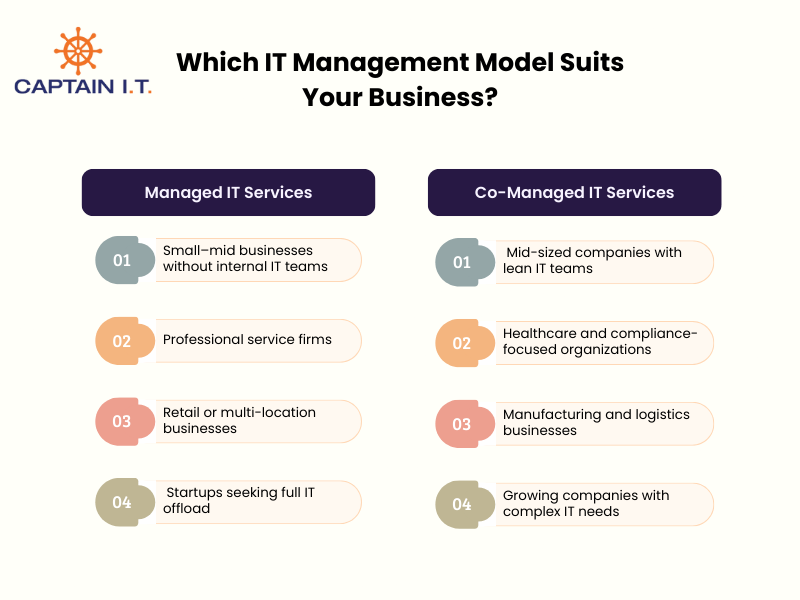
Managed IT Services
Managed IT Services suit organizations that want to fully delegate IT operations to a single provider. This model delivers centralized accountability for security, uptime, monitoring, help desk support, and ongoing maintenance through a trusted managed service provider, allowing businesses to operate without managing daily IT tasks internally.
Managed IT Services is best suited for:
- Small to mid-sized businesses (SMBs) without an internal IT team
- Professional service firms such as legal, accounting, and consulting offices
- Retail and multi-location businesses requiring consistent uptime
- Startups seeking predictable IT costs and full operational offload
Co-Managed IT Services
Co-Managed IT Services are designed for organizations that want to extend existing IT capabilities through collaboration rather than replace them. This hybrid model combines internal IT knowledge with external MSP support to fill gaps, improve scalability, and provide specialized expertise while retaining control over critical systems.
Co-Managed IT Services is best suited for:
- Mid-sized organizations with lean internal IT teams
- Healthcare providers managing compliance-driven environments
- Manufacturing and logistics businesses supporting operational systems
- Growing companies with fluctuating workloads or complex IT projects
When Should You Choose Managed IT Services vs Co-Managed IT Services?
The right choice between Managed IT Services and Co-Managed IT Services depends on how much IT responsibility your organization wants to offload versus retain, and how involved internal teams should remain in daily operations. Managed IT Services prioritize full offload and centralized accountability, while Co-Managed IT Services emphasize collaboration and shared responsibility for organizations with existing internal IT
Choose Managed IT Services when:
- You want to fully offload IT ownership and daily execution to one provider
- Internal IT resources are limited or not present
- Predictable monthly IT costs are a priority
- Centralized accountability for security, uptime, and support is required
- Standardized processes and minimal internal involvement are preferred
Choose Co-Managed IT Services when:
- You already have an internal IT team managing core systems or strategy
- You want to retain control while extending capacity through external support
- Gap-filling or specialized expertise is needed in areas like security or cloud
- Workloads fluctuate due to growth, projects, or compliance requirements
- Shared responsibility and collaborative IT governance align with your operations
FAQs
Is Co-Managed IT more expensive than Managed IT Services?
Co-managed IT services can be more expensive in total because organizations pay for both internal IT staff and external MSP support. Managed IT services typically offer lower overall complexity and predictable monthly costs because all IT responsibilities are fully outsourced to a single provider.
Do you need an Internal IT Team for Co-Managed IT Services?
Yes, co-managed IT services are designed for organizations that already have an internal IT team. The model works by extending internal capabilities through shared responsibility, gap-filling, and access to specialized expertise rather than replacing internal staff.
Can small businesses (SMBs) use Co-Managed IT Services?
Co-managed IT services are less common for very small businesses without internal IT staff. Small businesses usually benefit more from managed IT services, while co-managed IT is better suited for mid-sized organizations with at least one or two in-house IT professionals.
Which model offers better security: Managed IT or Co-Managed IT?
Both IT management models can deliver strong security outcomes when properly implemented. Managed IT services centralize security ownership with the MSP, while co-managed IT services share security responsibilities between internal teams and the provider. The better option depends on internal expertise, compliance requirements, and how security accountability is defined.
Can a business switch from Managed IT Services to Co-Managed IT Services?
Yes, many organizations start with managed IT services and transition to co-managed IT services as they grow and build internal IT capability. This shift allows businesses to retain more control over systems while continuing to rely on an MSP for specialized or high-demand functions.
How do Service-Level Agreements (SLAs) differ between the two models?
In managed IT services, SLA ownership, escalation paths, incident command, and risk ownership are fully assigned to the MSP. In co-managed IT services, SLAs are segmented, with responsibilities divided between the internal IT team and the MSP based on agreed governance, escalation paths, and compliance responsibility.