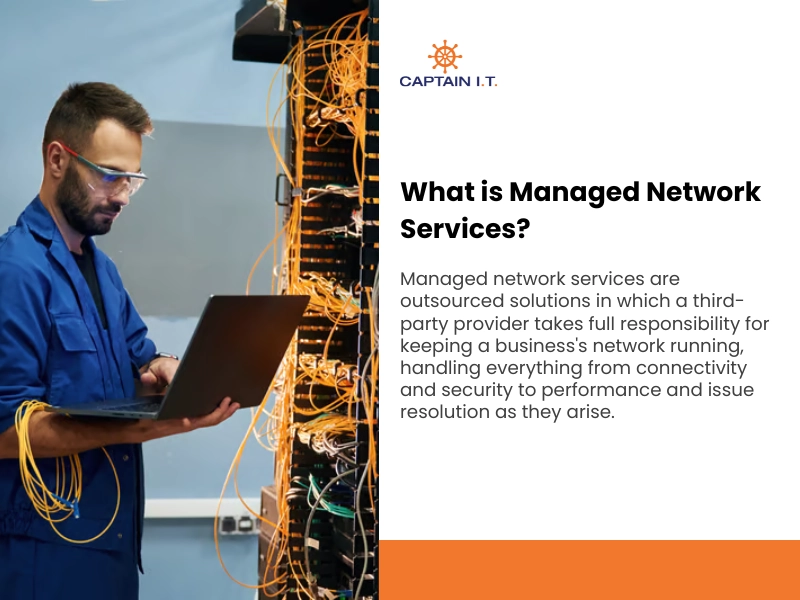
Managed network services refer to the outsourcing of network management, monitoring, security, and support to a managed service provider (MSP) that assumes responsibility for maintaining network performance, stability, and protection. The MSP manages network infrastructure, including connectivity, traffic flow, access control, and security enforcement, ensuring systems operate reliably without continuous internal intervention.
By shifting network operations to a managed service provider, businesses move from reactive issue handling to continuous, proactive management where monitoring, issue detection, and performance optimization happen in real time. This approach improves network reliability, reduces internal workload, and allows businesses to scale infrastructure without increasing operational complexity or resource dependency.
Who Needs Managed Network Services?
Managed network services are essential for businesses such as small and medium-sized businesses (SMBs), global enterprises, data-sensitive organizations, and remote or hybrid workforces facing challenges like limited IT resources, complex infrastructure, high security demands, and distributed operations. As these challenges increase reliance on stable and secure networks, businesses use managed network services to maintain reliable operations, protect systems, and ensure consistent network performance.
Key Organizations That Need Managed Network Services:
Small and Medium-Sized Businesses (SMBs): Lack dedicated IT staff, creating gaps in network management, monitoring, and security.
Enterprises with Global or Distributed Teams: Handle multi-location networks that require centralized control and consistent connectivity.
Companies Handling Sensitive Data: Manage regulated data that demands strong network security and compliance.
Organizations seeking to improve network performance: Face latency or downtime, necessitating ongoing optimization and monitoring.
Companies Needing 24/7 Support and Monitoring: Operate in environments that require real-time monitoring and rapid issue resolution.
Organizations Going Through Digital Transformation: Adopt cloud systems that require scalable and integrated network management.
Companies with Limited IT Resources: Lack the capacity to manage and scale network operations internally.
Remote or Hybrid Workforces: Rely on secure remote access and stable connectivity across distributed users.
- Small and Medium-Sized Businesses (SMBs)
Small and medium-sized businesses need managed network services because they lack dedicated IT staff to manage and secure network infrastructure, often relying on a small team or a single generalist, which limits continuous monitoring and delays responses to network issues. As a result, performance problems and security vulnerabilities often go unnoticed until they disrupt operations. A managed network service provider addresses this by managing infrastructure, monitoring systems in real time, and securing endpoints to maintain stable operations. - Enterprises with Global or Distributed Teams
Businesses operating across multiple locations need managed network services to maintain centralized control and visibility over network activity. Different setups, providers, and routing paths create fragmented environments, making it difficult for internal teams to trace and resolve issues quickly. This often leads to delays in diagnosing latency issues and routing failures. A managed network service provider centralizes monitoring and standardizes configurations, enabling faster issue resolution and consistent network performance across all locations. - Companies Handling Sensitive Data
Companies that store and process sensitive data need managed network services to meet strict regulatory requirements for continuous compliance, audit readiness, and controlled access to systems. In-house teams often struggle to maintain the level of oversight required for standards such as HIPAA, PCI DSS, and GDPR, leading to compliance gaps. In environments that handle patient or financial data, even brief lapses can lead to violations, penalties, or unauthorized access, making an MSP essential for consistent regulatory compliance. - Organizations Seeking to Improve Network Performance
Frequent slowdowns, latency spikes, bandwidth congestion, and uneven traffic flow push organizations to seek managed network services when internal teams cannot pinpoint or resolve performance issues. These problems often stem from misconfigurations or inefficient routing that go unnoticed without continuous analysis, gradually degrading application performance and user experience. As these disruptions affect daily operations, businesses turn to a managed service provider to identify root causes and restore consistent network efficiency. - Companies Needing 24/7 Support and Monitoring
When operations extend beyond business hours, companies need managed network services because issues often occur when no team is available to detect or respond. This creates gaps where failures escalate unnoticed until systems are disrupted. Most internal teams cannot provide continuous oversight, leaving networks exposed at night, on weekends, or during peak periods. In environments like e-commerce or customer-facing platforms, this lack of real-time response leads to prolonged outages and operational disruption. - Organizations Going Through Digital Transformation
When cloud platforms are introduced alongside legacy systems, managed network services are necessary to manage communication across environments with different architectures. As these systems fail to integrate seamlessly, IT teams struggle to resolve compatibility issues, leading to broken data exchange or unstable connections. In setups combining platforms like Microsoft Azure with existing systems, such disruptions occur frequently. Managed network services provide centralized control over configurations and connectivity, aligning systems and stabilizing operations. - Companies with Limited IT Resources
When limited internal IT capacity restricts continuous network oversight, issue resolution, and performance tracking, managed network services become necessary to maintain operational stability and prevent disruptions. Small or overstretched teams often manage multiple systems, which makes consistent monitoring and maintenance difficult. In many cases, one or two IT staff members manage the entire environment, resulting in delayed updates and unresolved issues. These services address this by ensuring consistent management and reducing disruptions caused by limited internal resources. - Remote or Hybrid Workforces
When limited internal IT capacity restricts continuous network oversight, issue resolution, and performance tracking, managed network services become necessary to maintain stability and prevent disruptions. Small or overstretched teams often manage multiple systems, making consistent monitoring and maintenance difficult. In many cases, one or two IT staff handle the entire environment, leading to delayed updates and unresolved issues, which these services address by ensuring consistent management and reducing disruptions caused by limited internal resources.
What Are the Types of Managed Network Services?
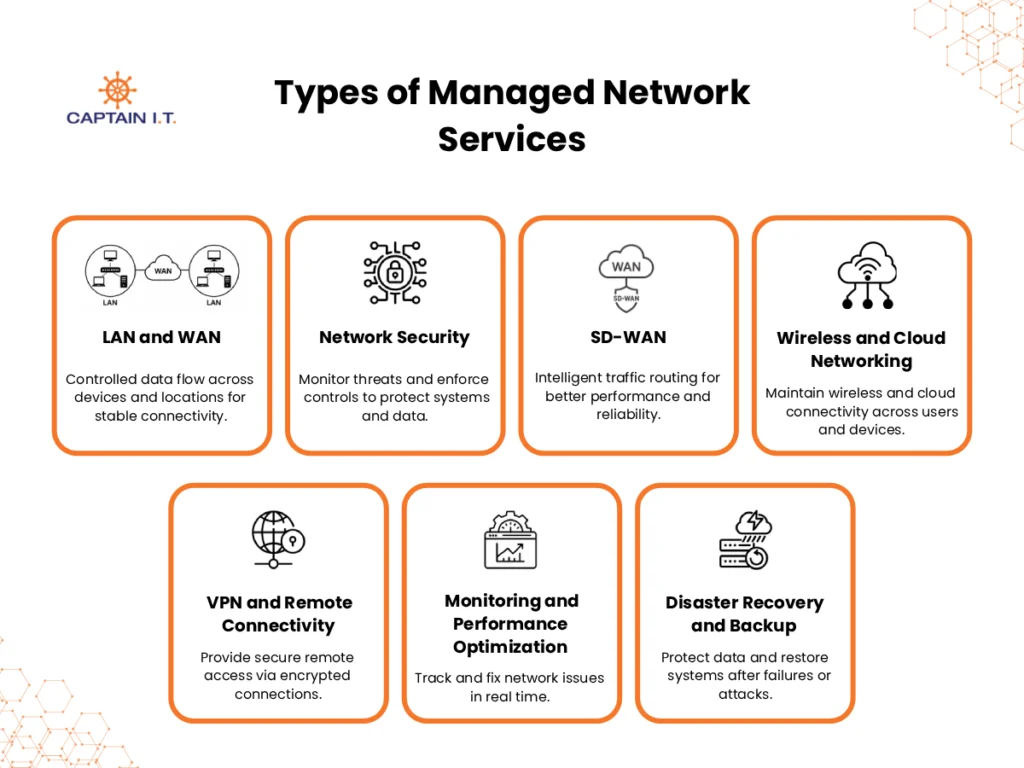
The types of managed network services are LAN and WAN management, network security, SD-WAN, wireless and cloud networking, VPN connectivity, and disaster recovery solutions, each designed to manage specific aspects of network infrastructure and operations. These services cover different layers of network infrastructure, security, performance, and recovery, depending on business requirements. As each service focuses on a specific function, they work together to ensure communication, protection, and continuity are managed in a coordinated and structured manner.
7 key types of managed network services are:
Managed LAN and WAN Services: Controlled data flow across devices, offices, and locations to maintain stable connectivity.
Managed Network Security: Monitor threats and enforce security controls to protect systems and data.
Managed SD-WAN: Route traffic intelligently to improve performance and connection reliability.
Managed Wireless and Cloud Networking: Maintain wireless access and cloud connectivity across users and devices.
Managed VPN and Remote Connectivity: Provide secure remote access through encrypted network connections.
Network Monitoring and Performance Optimization: Track network activity and fix performance issues in real time.
Disaster Recovery and Backup Services: Protect data and restore systems quickly after failures or attacks.
- Managed LAN and WAN services
Managed LAN and WAN services are network management services that control and maintain the connections of local area networks (LANs) and wide area networks (WANs) to devices, users, and business locations across an organization. These services define network architecture, configure routing protocols, and maintain connections among offices, data centers, and remote sites to ensure consistent, controlled data flow.
As these connections expand across locations, unmanaged networks often become fragmented, leading to communication breakdowns, inconsistent data transfer, and inefficient routing. This lack of coordination affects how systems interact across sites. Managed LAN and WAN services address this by maintaining stable site-to-site connectivity, optimizing traffic flow between locations, and ensuring reliable communication across the network regardless of scale or complexity. - Managed Network Security
Protecting network infrastructure from unauthorized access and cyber threats is the core function of managed network security, which monitors activity, controls access, and enforces security policies across all systems and connections. It uses firewalls, intrusion detection systems, and access controls to inspect traffic, identify unauthorized behaviour, and block threats before they affect systems, ensuring only authorized users and devices interact with the network.
With every additional user, device, or access point, maintaining consistent protection becomes more complex and demanding. Continuous enforcement of security policies across all connections helps maintain control, reduce exposure to threats, limit unauthorized activity, and keep systems protected without interrupting normal operations. - Managed SD-WAN
By using software-defined control to route traffic across wide-area networks, managed SD-WAN directs how data moves based on application needs and real-time network conditions. It applies centralized rules to send traffic across multiple connections, such as broadband, MPLS, or LTE, while prioritizing critical applications and maintaining visibility into performance across locations.
As network usage shifts toward cloud platforms and distributed systems, traffic becomes harder to manage with fixed routing paths. This leads to delays and inconsistent performance across locations. Managed SD-WAN addresses this by continuously checking network conditions and rerouting traffic to avoid congestion, latency, or packet loss, ensuring stable and reliable application performance. - Managed Wireless and Cloud Networking
Wireless and cloud networking is a network service that manages the infrastructure and connectivity that enable devices to access Wi-Fi networks and cloud-based systems across distributed environments. It manages wireless access points, controls user connections, and ensures devices can reliably access cloud applications without interruption.
Growing reliance on wireless access and cloud platforms makes maintaining consistent connectivity harder without centralized oversight. Unmanaged setups often result in weak signal coverage, dropped connections, and inconsistent access across locations, which disrupts user interaction with applications. This service maintains strong coverage, balances network load, and ensures stable communication between devices and cloud systems. - Managed VPN and Remote Connectivity
By controlling how users connect to internal systems from external networks, managed VPN and remote connectivity services provide secure remote access across different locations and devices. It establishes encrypted connections and enforces authentication controls, allowing employees to access business resources safely without exposing sensitive data.
Since these connections originate outside controlled environments, they introduce higher risks if not properly managed. Unsecured access points can expose systems to unauthorized entry and data leaks. To mitigate this, the service verifies user access, secures each connection, and maintains encrypted communication, ensuring remote access remains controlled and protected across distributed work environments. - Network Monitoring and Performance Optimization
Network monitoring and performance optimization is a service that tracks network activity and manages data flow to maintain speed, stability, and reliability across systems. It analyzes traffic patterns, system behaviour, and usage trends to detect slowdowns, bottlenecks, or irregular performance.
Over time, shifting demand and usage patterns can degrade performance if left unaddressed, often affecting application response and system reliability. Continuous monitoring helps identify the root cause of slowdowns and refine configurations, keeping data flow efficient, maintaining stability, and reducing disruptions across the network. - Disaster Recovery and Backup Services
By creating, storing, and restoring copies of critical data, disaster recovery and backup services serve as a category of services that protect business systems during disruptions. This includes automated backups, system replication, off-site or cloud storage, and structured recovery planning to ensure data remains available during hardware failures, cyberattacks, or system outages.
To ensure these protections are effective during actual disruptions, backup and recovery processes must be clearly structured and consistently maintained. Defined storage methods, backup frequency, and restoration procedures enable systems to recover without data loss, minimize downtime, and resume operations quickly after unexpected events.
How Do Managed Network Services Work?
Managed network services operate through a structured, continuous process in which networks are set up, monitored, and maintained to ensure performance, security, and reliability. This lifecycle connects initial setup with ongoing monitoring, issue resolution, and continuous adjustments as network demands change. Understanding this process highlights how continuous oversight ensures stable operations and consistent network performance over time.
7 Core Mechanisms of Managed Network Services
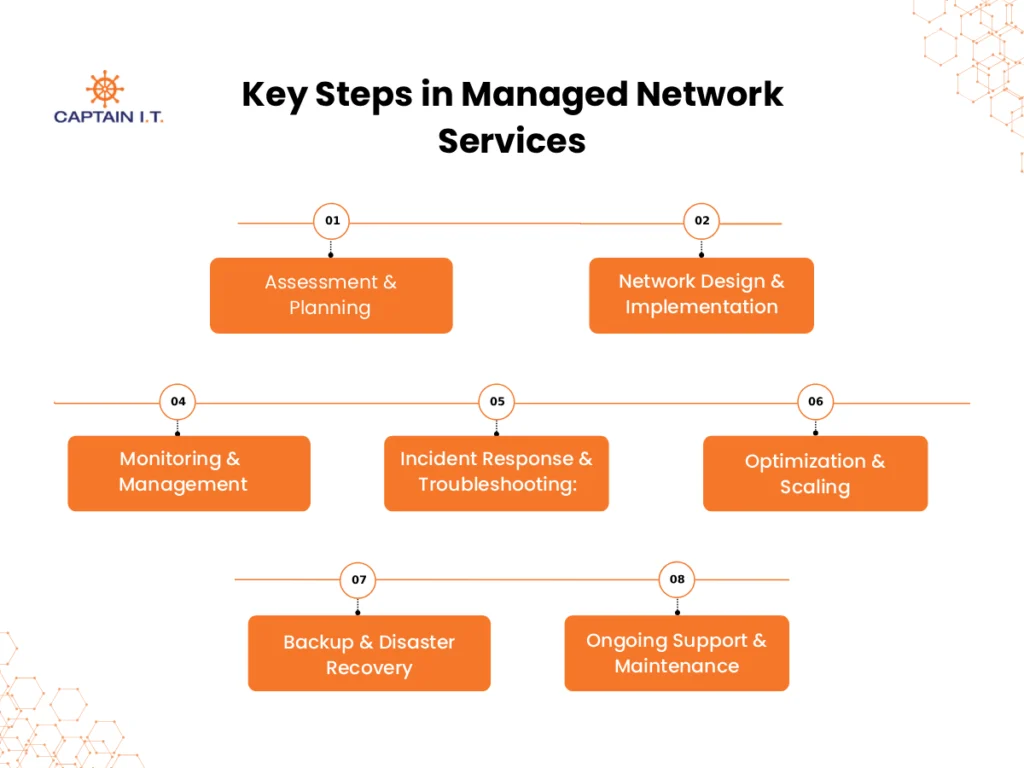
Assessment & Planning: Evaluate the current network to identify gaps, risks, and requirements for proper setup.
Network Design & Implementation: Configure network architecture, devices, and connections to align with business needs.
Monitoring & Management: Continuously track network activity to maintain stability and detect issues early.
Incident Response & Troubleshooting: Identify and resolve network issues quickly to restore normal operations.
Optimization & Scaling: Adjust network performance and resource allocation to handle growth and changing demand.
Backup & Disaster Recovery: Maintain backups and recovery processes to restore systems after failures or attacks.
Ongoing Support & Maintenance: Perform updates and routine checks to keep the network secure and stable.
- Assessment & Planning
Assessment and planning are the first steps, during which the current network is thoroughly evaluated to identify gaps, risks, performance issues, and capacity limitations that can affect stability and scalability. At this stage, network infrastructure, devices, traffic flow, and security are reviewed to pinpoint inefficiencies and weak points. This establishes a clear baseline for what needs to be addressed. With this clarity, the network design and implementation stage can be carried out accurately and without errors. - Network Design & Implementation
After the network is assessed, the next step is to build and configure it to meet the identified needs and requirements by setting up the network architecture, devices, and connections to ensure that communication flows correctly and that known issues are addressed. A well-structured setup is important because it prevents future performance or security problems. Once the network is properly configured, it becomes ready for continuous monitoring and management to keep it running efficiently. - Monitoring Management
Once the network is in place, monitoring and management keep it running smoothly by providing real-time visibility into network activity and system health. Network performance, traffic patterns, and bandwidth usage are continuously analyzed to detect irregular behaviour early. This step matters because early detection prevents minor issues from escalating into major disruptions. When an issue is identified, the process moves into incident response and troubleshooting to restore normal operations. - Incident Response & Troubleshooting
When network problems interrupt work, incident response and troubleshooting focus on quickly isolating the root cause and restoring stable network function. Alerts are analyzed, and network behaviour is traced across systems and connections to pinpoint where the failure occurs. Quick resolution is critical, as delays can allow issues to spread and impact overall network performance. Once the issue is resolved, the process moves into optimization and scaling to strengthen network stability and prevent recurrence. - Optimization & Scaling
As network demand increases, the network is adjusted and expanded to maintain performance and support higher usage. Configurations and capacity are refined to handle growing traffic, users, and applications without causing slowdowns. Without these adjustments, increased demand can lead to congestion and reduced efficiency across the network. Once performance is stabilized, the process moves into backup and disaster recovery to protect against potential failures. - Backup & Disaster Recovery
Unexpected failures, cyberattacks, or system outages require backup and disaster recovery as a critical stage to restore systems and data. At this stage, automated backups are created at scheduled intervals or in real time and stored in secure cloud or off-site locations to prevent data loss. When a disruption occurs, recovery processes initiate data restoration and system failover to bring systems back online quickly, ensuring operations resume with minimal downtime and preventing prolonged business disruption. - Ongoing Support & Maintenance
To keep the network running reliably over time, ongoing support and maintenance ensure it stays stable, secure, and up to date after deployment and optimization. Regular updates, system checks, and performance reviews help identify and prevent issues before they impact operations. Without proper maintenance, networks can become outdated, vulnerable, and prone to unexpected failures. Continuous support keeps the network reliable and responsive to changes in usage and system demands.
What Are the Different Pricing Models for Managed Network Services?
The pricing models for managed network services include fixed, scalable, monitoring-only, project-based, and performance-based options. These pricing structures are designed to match different business needs, budgets, and network complexity, allowing companies to choose pricing based on usage, scope, or outcomes. Each model fits specific scenarios, such as predictable monthly costs, flexible scaling, or pay-for-performance, helping businesses align network management costs with their operational requirements.
Key Pricing Models for Managed Network Services
Fixed Pricing Models: A fixed monthly fee based on a defined scope of services, providing predictable and stable costs for businesses.
Scalable Pricing Models: Pricing based on users, devices, or network size, allowing costs to scale up or down with business demand.
Monitoring-Only Pricing: Include network visibility and alerts without full management, enabling internal teams to handle issue resolution.
Project-Based or One-Time Pricing: Charge a one-time fee for specific services such as network setup, upgrades, or migrations.
Performance-Based Pricing: Based on service outcomes such as uptime or response time, aligning costs with network performance.
- Fixed Pricing Models
Fixed pricing models offer a flat monthly fee for managed network services, ranging from $1,000–$5,000, or about $120–$300 per user and $100–$400 per device, depending on network size and support level. Pricing can be structured per network, user, or device, and includes defined services such as monitoring, maintenance, and support, which keep costs consistent despite minor usage changes. This consistency makes the model suitable for small to mid-sized businesses that need predictable expenses and stable network management. - Scalable Pricing Models
For networks where usage, user count, and service needs change over time, pricing adjusts dynamically, ranging from $75–$350 per user, $150–$600 per device, or variable monthly fees based on support level and complexity. Costs adapt through usage-based billing tied to consumption, tiered plans that bundle services, or à la carte options for specific needs. This model keeps spending aligned with actual network demand and is well-suited for growing businesses, startups, or organizations requiring flexible cost control. - Monitoring Only Pricing
Monitoring-only pricing costs around $2 to $200+ per device per month, providing 24/7 network monitoring and alerting without full management. This model tracks network activity and performance, and monitors alerts in real time, while leaving issue resolution and maintenance to internal teams. Pricing varies based on monitoring depth, alerting level, and tools used. This model works well for organizations with in-house IT teams that need constant oversight without outsourcing full network control. - Project-Based or One-Time Pricing
Project-based or one-time pricing ranges from $1,000 to $10,000+ per project, covering work such as network setup, infrastructure upgrades, migrations, or security implementations, with no ongoing commitments. This model suits businesses that need a defined outcome within a fixed scope and timeline, rather than continuous management. As requirements vary, costs depend on project complexity, network size, and expertise needed, making it suitable for organizations seeking targeted changes without long-term service agreements. - Performance-Based Pricing
Performance-based pricing ranges from $500 to $3,000+ per month, with costs determined by factors such as uptime targets, response times, SLA requirements, and overall network performance expectations. This model links pricing directly to measurable outcomes, meaning businesses pay based on how well the network meets defined performance standards. This model appeals to organizations where performance guarantees directly impact daily operations.
What Are the Benefits of Managed Network Services?
The benefits of managed network services include improved network performance, expert support, stronger security, scalability, reduced downtime, and better focus on core business operations. These benefits result from a unified system in which monitoring, security, optimization, and support work together in real time, keeping networks reliable and efficient. Understanding these benefits shows how managed network services reduce internal workload, prevent issues from escalating, stabilize costs, and support business growth without added complexity.
7 Benefits of Managed Network Services are:
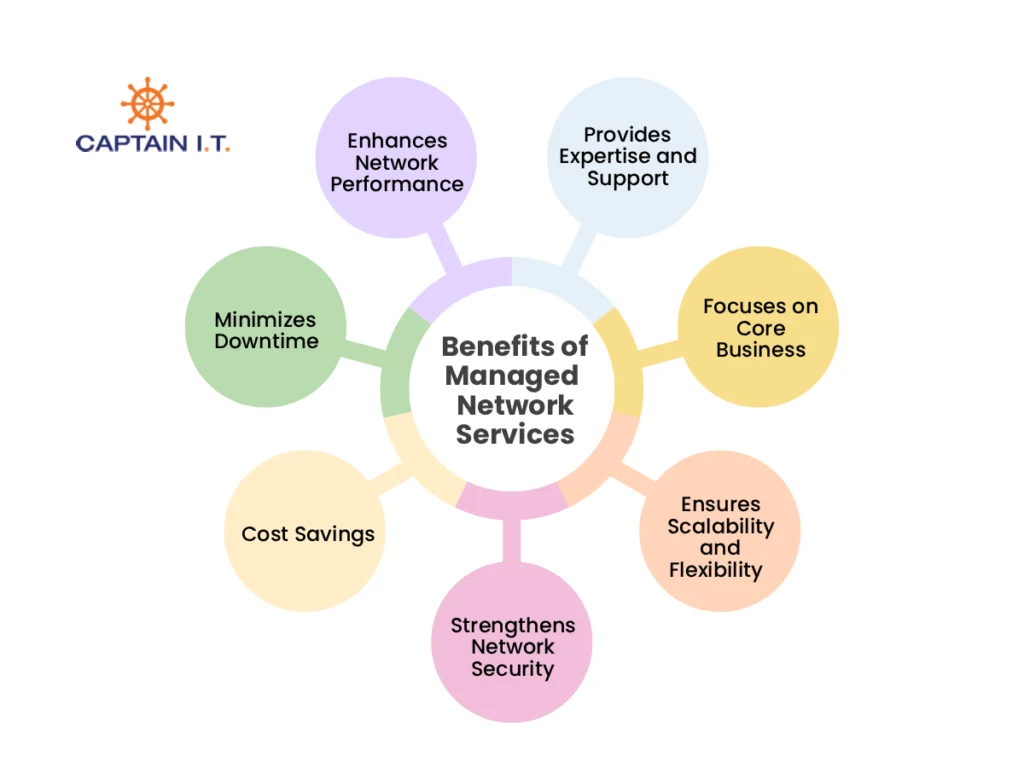
Enhances Network Performance: Keeps your network optimized in real time to ensure fast, reliable connectivity and a better user experience.
Provides Expertise and Support: Gives you direct access to skilled network and security professionals who handle issues efficiently and accurately.
Focuses on Core Business: Frees your internal team from IT burdens, allowing them to prioritize growth and strategic initiatives.
Ensures Scalability and Flexibility: Allows your network to grow and adapt بسهولة with your business without major disruptions or reinvestment.
Strengthens Network Security: Protects your infrastructure with advanced, continuously updated security measures against evolving cyber threats.
Cost Savings: Reduces unpredictable IT expenses with fixed, manageable pricing and eliminates large capital investments.
Minimizes Downtime: Prevents disruptions through proactive monitoring and rapid response, keeping your operations running smoothly.
- Enhances Network Performance
Managed network services improve network performance by actively managing traffic flow, reducing latency, and maintaining stable, high-speed connectivity across systems. Poor network performance slows down critical processes and disrupts daily operations, which these services address by stabilizing connections so employees can access applications without lag, complete tasks efficiently, and collaborate across teams. This results in improved productivity, smoother customer experiences, more consistent operations, and reduced revenue loss due to performance issues. - Provides Expertise and Support
By giving businesses access to experienced network engineers and security experts, managed network services ensure issues are diagnosed accurately, resolved quickly, and prevented from recurring. Their specialized knowledge, advanced tools, and continuous oversight improve troubleshooting precision and reduce resolution time, especially for complex network problems. This approach strengthens system reliability, minimizes downtime, and ensures operations continue smoothly without delays or costly disruptions. - Focuses on Core Business
With managed network services taking over the ongoing management, monitoring, and support of network infrastructure, businesses can eliminate the constant drain of IT-related distractions on internal teams. This shift allows employees and leadership to prioritize revenue-generating work, accelerate decision-making, and improve customer-facing activities, leading to stronger business performance and more efficient use of internal resources. - Ensures Scalability and Flexibility
Growth should never be limited by your network, and managed network services ensure your infrastructure can expand or adjust as your business evolves. Instead of facing delays, capacity issues, or costly upgrades, businesses can quickly adapt to new demands, whether adding users, expanding locations, or shifting to cloud environments, allowing operations to continue smoothly while supporting long-term growth without unnecessary complexity or disruption. - Strengthens Network Security
By actively reducing the risk of cyberattacks, data breaches, and unauthorized access, managed network services help protect operations from disruption. This helps maintain business continuity, reduce financial exposure from incidents such as ransomware attacks, support compliance with regulations such as HIPAA and GDPR, and preserve customer trust, ensuring long-term stability in an increasingly complex threat landscape. - Cost Savings
Better cost control and reduced total IT spending are key advantages of managed network services, allowing businesses to eliminate unpredictable expenses and optimize how every dollar is spent on network infrastructure. By shifting from reactive spending to a predictable service model, businesses can avoid costly downtime, reduce emergency repair expenses, and eliminate the need for large upfront investments, resulting in more efficient budgeting and stronger long-term return on IT investments. - Minimizes Downtime
Consistent network uptime keeps business operations running without interruption, and managed network services help prevent outages that can impact productivity and revenue. Faster detection and resolution of issues shorten the duration of disruptions and prevent small problems from escalating into major failures. This ensures critical systems stay accessible, helping businesses maintain workflow continuity, meet service expectations, and avoid costly losses from downtime or missed opportunities.
What Are the Challenges of Managed Network Services?
The challenges of managed network services include reduced control over network infrastructure, reliance on vendor reliability, and limited flexibility, which affect how networks are managed and adapted over time. These issues arise when businesses shift critical operations to an external provider, placing key decisions outside the organization, slowing changes, limiting customization, and tying performance to the provider’s quality. This makes choosing the right partner essential to avoid misalignment, service gaps, and long-term inefficiencies.
- Limited Control Over Network Infrastructure
Handing over network infrastructure to a managed service provider means the business loses direct control over how systems are configured, updated, or prioritized. Even small changes may require provider involvement, which can slow response times. Over time, this reduced control can delay critical projects, limit customization, and reduce visibility into key decisions, making it harder for the business to stay agile and respond quickly to changing needs. - Dependence on Vendor Reliability
Business continuity becomes closely tied to the provider’s performance when using managed network services, making vendor reliability critical. If the provider responds slowly, misses issues, or delivers inconsistent support, it can disrupt operations, delay resolution, and affect network stability. Over time, this reliance increases the risk of downtime, inconsistent service quality, and reduced control over the speed at which critical issues are resolved, making provider performance a key factor in overall business stability. - Operational Efficiency and Resource Limitations
Managed network services can create operational inefficiencies when responsibilities are split between internal teams and external providers, leading to coordination gaps and poor resource use. Misalignment can slow execution, create confusion about ownership, and lead to duplicated or missed tasks, especially in complex environments. This increases costs, delays critical initiatives, and reduces efficiency, making it harder for businesses to operate smoothly, maintain performance, and respond effectively to changing demands.
How Does Managed Network Services Compare to In-House IT Networking?
Managed network services offer outsourced expertise, scalability, and proactive management, while in-house IT networking provides full control, customization, and direct oversight. The choice depends on whether a business prioritizes flexibility and internal control or efficiency, expertise, and reduced operational burden.
| Factor | Managed Network Services | In-House IT Networking |
| Control | Limited direct control, managed by the provider | Full control over network setup and decisions |
| Expertise | Access to specialized engineers and security experts | Depends on internal team skills and experience |
| Cost Structure | Predictable monthly costs, lower upfront investment | High costs for hiring, training, and infrastructure |
| Scalability | Easily scales with business growth | Scaling requires additional hiring and resources |
| Monitoring & Support | Continuous monitoring and proactive issue resolution | Limited to internal team availability and capacity |
| Customization | Standardized processes with some flexibility | Fully customizable based on internal preferences |
How to Choose the Right Managed Network Services Provider?
Choosing the right managed network services provider means selecting a partner that can reliably manage your network, strengthen security, support scalability, and align with your long-term business goals. To achieve this, the provider should act as an extension of your business, combining expertise, security, scalability, responsiveness, and accountability to deliver consistent performance without added complexity. As a result, working with an experienced managed network service provider ensures proactive management, reliable support, and a network aligned with your needs, allowing you to focus on growth with confidence.