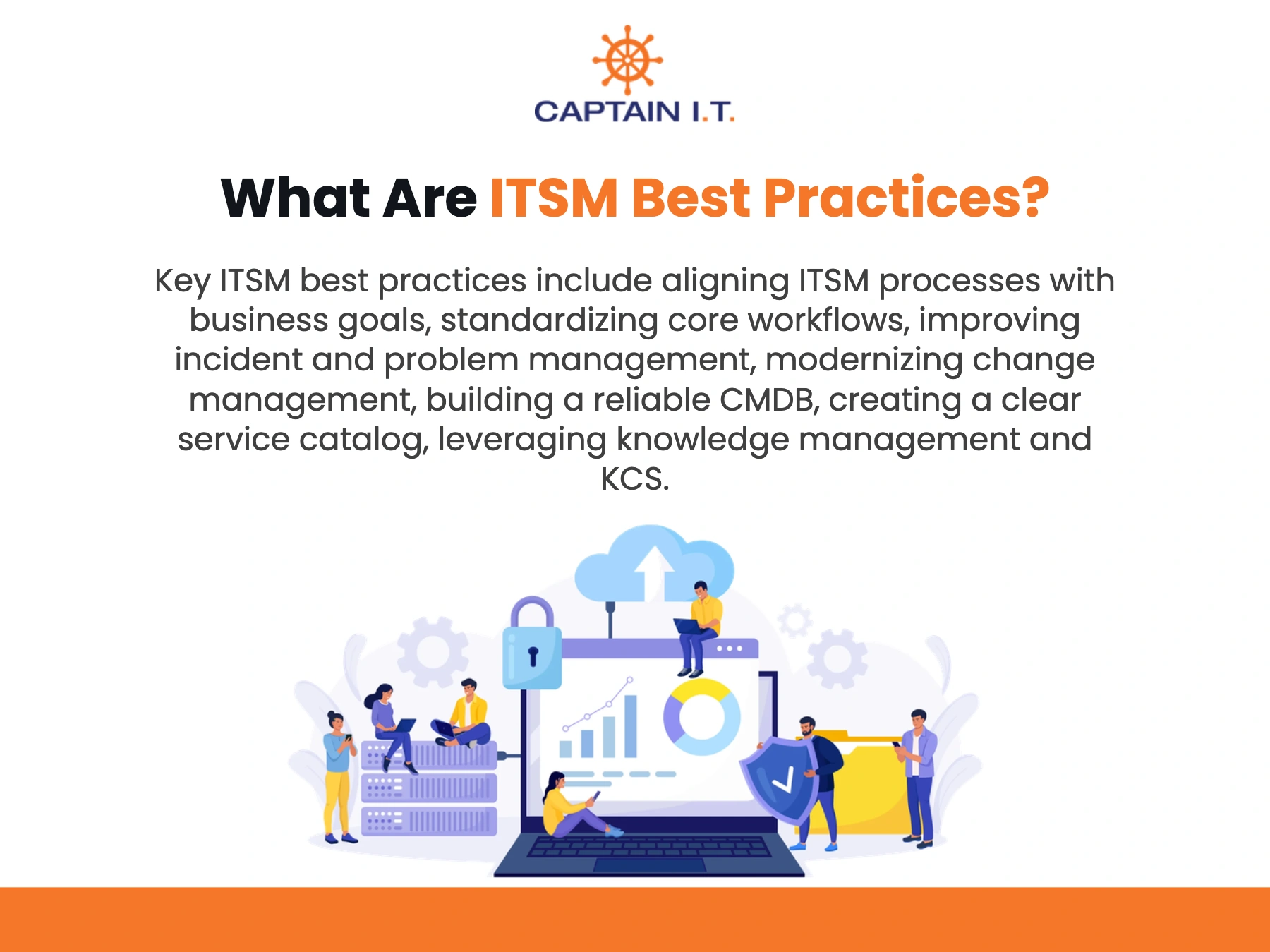
Effective IT Service Management (ITSM) helps SMBs improve service quality, reduce operational risks, and align IT with business goals by implementing best practices such as standardized ITSM processes, incident, problem, and change management, a reliable CMDB, and a clear service catalog. Additionally, it improves efficiency through knowledge management, KCS, self-service portals, ticket automation, defined SLAs and OLAs, and KPI tracking such as MTTR, backlog, resolution rate, and CSAT.
For Managed Service Providers (MSPs), adopting ITSM best practices is particularly important because it enables consistent service delivery, stronger client satisfaction, and more efficient resource management. The success of these ITSM best practices depends on factors such as process automation maturity, knowledge management effectiveness, change management rigor, tool integration and interoperability, SLA definition and enforcement, asset and configuration accuracy, cross-functional stakeholder alignment, and strong root cause analysis capabilities. Together, these factors help MSPs and businesses deliver reliable, scalable, and customer-focused IT services.
12 IT Service Management best practices include:
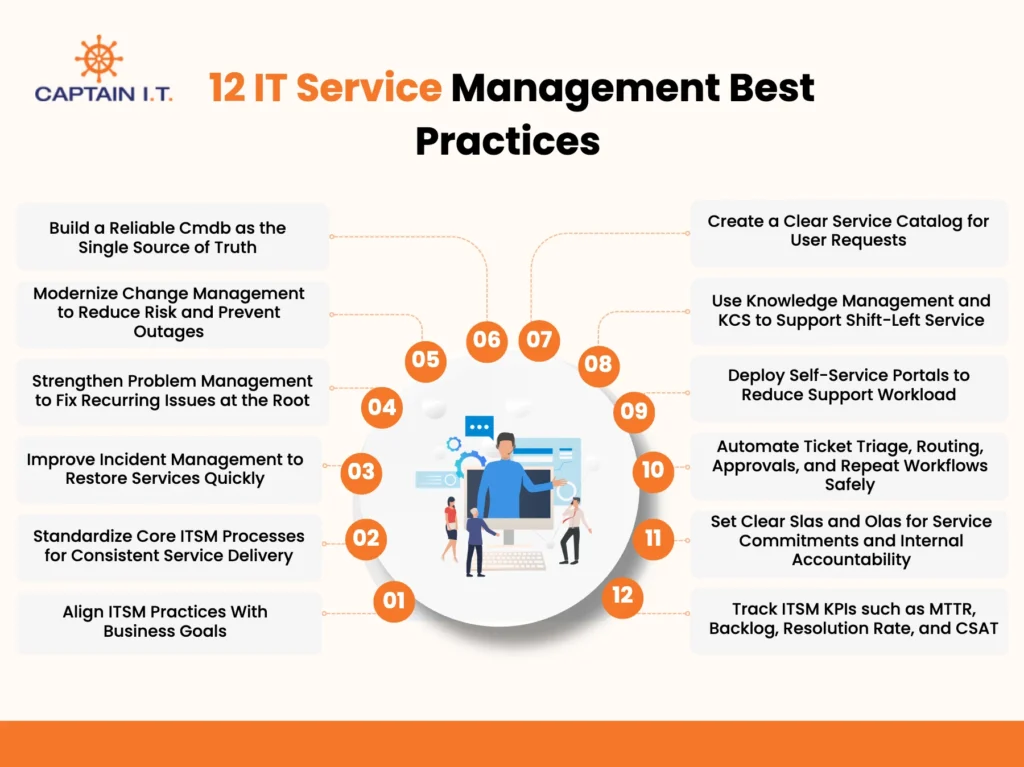
- Align ITSM Practices With Business Goals
- Standardize Core ITSM Processes for Consistent Service Delivery
- Improve Incident Management to Restore Services Quickly
- Strengthen Problem Management to Fix Recurring Issues at the Root
- Modernize Change Management to Reduce Risk and Prevent Outages
- Build a Reliable Cmdb as the Single Source of Truth
- Create a Clear Service Catalog for User Requests
- Use Knowledge Management and KCS to Support Shift-Left Service
- Deploy Self-Service Portals to Reduce Support Workload
- Automate Ticket Triage, Routing, Approvals, and Repeat Workflows Safely
- Set Clear Slas and Olas for Service Commitments and Internal Accountability
- Track ITSM KPIs such as MTTR, Backlog, Resolution Rate, and CSAT
Align ITSM Practices With Business Goals
Integrating ITSM practices with business goals helps businesses ensure that IT services support growth, operational efficiency, and customer satisfaction. For small and medium-sized businesses (SMBs), this integration is particularly important because limited budgets and resources require every IT investment to deliver measurable value.
Businesses should assess current IT capabilities, identify service gaps, and connect processes such as incident management, problem management, and continual improvement to strategic priorities. Gartner states that business-aligned ITSM improves service quality and reduces operational risk. Regular KPI tracking and stakeholder reviews help businesses maintain reliable, cost-effective IT services that adapt to changing requirements and support long-term business success.
Standardize Core ITSM Processes for Consistent Service Delivery
Establishing standardized ITSM workflows creates a consistent framework for managing IT services, reducing operational variability, and improving service reliability. Core practices include incident management, request fulfillment, problem management, change management, and knowledge management. Consistent workflows ensure incidents are resolved systematically, service requests are handled efficiently, root causes are identified proactively, and changes are deployed with lower risk.
A structured knowledge base also enables faster issue resolution and supports self-service access to information. These practices improve operational efficiency, strengthen service quality, and create a more predictable IT environment. For SMBs, standardized ITSM processes help small IT teams, including those using managed IT solutions, deliver dependable services while managing resources effectively.
Improve Incident Management to Restore Services Quickly
Restoring services quickly requires a structured ITSM incident management process that identifies, prioritizes, and resolves IT issues with minimal disruption to business operations. Defined workflows, escalation procedures, and service-level targets help IT teams respond consistently and maintain service availability.
Effective ITSM incident management also relies on centralized ticketing systems, real-time monitoring, and automated alerts that accelerate response times and improve issue visibility. For example, a typical incident response plan may assign a help desk technician to triage incoming requests, escalate unresolved issues to a network specialist, and notify management of a critical system outage. This approach helps businesses maintain service continuity and customer trust.
Strengthen Problem Management to Fix Recurring Issues at the Root
Eliminating recurring IT issues requires a structured ITSM problem management process that identifies root causes rather than repeatedly addressing symptoms. By analyzing incident trends, linking related tickets, and conducting root cause analysis, IT teams can uncover the underlying factors behind recurring service disruptions.
Maintaining a Known Error Database (KEDB) helps document identified causes, workarounds, and permanent fixes, enabling faster resolution of similar incidents. Clear ownership and defined responsibilities further improve accountability and the efficiency of resolution. Effective problem management reduces incident recurrence, improves service stability, and supports more reliable IT service delivery while minimizing operational disruptions and support costs.
Modernize Change Management to Reduce Risk and Prevent Outages
Building on effective problem management, implementing controlled changes is a key ITSM best practice for reducing operational risk and preventing service outages. A structured change management process ensures that every IT system change is assessed, approved, tested, and implemented with proper oversight. Clear roles and responsibilities improve accountability, while standardized workflows help maintain service stability and support business objectives.
Aligning these workflows with ITIL recommendations helps businesses balance service stability with operational agility while reducing the risk of unauthorized or poorly planned changes. This approach is particularly valuable for SMBs, where even minor service disruptions can significantly impact productivity, customer experience, and day-to-day operations.
Build a Reliable Cmdb as the Single Source of Truth
Knowing exactly how IT assets, applications, and services are connected is critical for effective ITSM, which is why maintaining a reliable Configuration Management Database (CMDB) is considered a best practice. A CMDB serves as a centralized source of truth, storing information about hardware, software, and network devices, as well as their relationships. This visibility helps IT teams perform faster incident resolution, more accurate root cause analysis, and better change impact assessments.
To maintain reliability, SMBs should use automated discovery tools, establish clear ownership, and conduct regular audits to keep configuration data accurate. A well-managed CMDB strengthens incident, problem, and change management while reducing operational risk and supporting informed decision-making.
Create a Clear Service Catalog for User Requests
Providing users with a centralized location to access and request IT services is a key ITSM best practice that improves both service accessibility and request management. A service catalog presents available services, such as software access, hardware support, and account management, in a clear and organized format, helping users quickly find what they need. Standardized request forms and predefined workflows streamline request fulfillment and improve response consistency.
Integrating the catalog with a knowledge base enables users to resolve common issues independently, reducing service desk workload. A well-maintained service catalog improves user satisfaction, supports service efficiency, and ensures IT services remain aligned with business priorities.
Use Knowledge Management and KCS to Support Shift-Left Service
Using knowledge management and Knowledge-Centered Service (KCS) is an ITSM best practice for supporting shift-left service and reducing repeated support effort. Knowledge management organizes FAQs, troubleshooting guides, and how-to articles so users and frontline teams can resolve common issues faster. KCS improves this process by making knowledge creation part of daily incident resolution, ensuring that new fixes are captured, reused, and continuously updated.
When integrated with the service desk and self-service portal, these practices reduce escalations, improve first-contact resolution, and shorten response times. They also help SMBs identify knowledge gaps, update outdated content, and deliver more reliable IT support.As a result, support teams spend less time resolving repetitive issues and more time addressing complex business needs.
Deploy Self-Service Portals to Reduce Support Workload
Providing users with direct access to IT services through a self-service portal is an ITSM best practice that reduces support workload and improves service efficiency. A self-service portal enables users to submit requests, access knowledge articles, and resolve common issues such as password resets or software access without contacting the service desk. This reduces ticket volumes, shortens resolution times, and provides 24/7 access to support resources.
By automating routine requests, IT teams can focus on complex incidents and strategic initiatives rather than repetitive tasks. To maximize adoption, SMBs should maintain an intuitive portal, keep knowledge content up to date, and provide clear escalation paths when human assistance is required.
Automate Ticket Triage, Routing, Approvals, and Repeat Workflows Safely
Automating ticket triage, routing, approvals, and repetitive workflows is a core component of effective ITSM, helping SMBs improve service efficiency while maintaining process consistency. Automation uses predefined rules to categorize tickets, assign them to the appropriate support teams, trigger approval requests, and escalate incidents based on priority or service-level requirements.
This approach reduces manual effort, minimizes routing errors, and accelerates response and resolution times. Automated workflows also strengthen governance by ensuring approvals, notifications, and process steps follow established policies. By eliminating repetitive administrative tasks, IT teams can focus on complex issues, improve service quality, and scale operations more efficiently without increasing support overhead.
Set Clear Slas and Olas for Service Commitments and Internal Accountability
Defining clear Service Level Agreements (SLAs) and Operational Level Agreements (OLAs) is a key practice within ITSM frameworks, establishing service commitments and creating accountability across support teams. SLAs define measurable targets, such as response times, resolution times, and service availability, between IT service providers and customers, while OLAs outline the internal responsibilities and performance expectations required to achieve those targets.
Strong alignment between SLAs and OLAs ensures that operational processes support agreed service levels and customer expectations. To remain effective, these agreements should include realistic metrics, clearly assigned ownership, and regular performance reviews. Well-managed SLAs and OLAs improve service consistency, reduce operational risks, and help businesses maintain reliable IT service delivery.
Track ITSM KPIs such as MTTR, Backlog, Resolution Rate, and CSAT
Monitoring ITSM key performance indicators (KPIs) is a fundamental element of modern ITSM because it helps SMBs evaluate service effectiveness, operational efficiency, and user satisfaction. Key metrics include Mean Time to Resolution (MTTR), which measures how quickly incidents are resolved, backlog, which tracks unresolved tickets awaiting action, resolution rate, which indicates the percentage of successfully completed requests, and Customer Satisfaction (CSAT), which reflects user perceptions of service quality.
Tracking these KPIs regularly enables IT teams to identify recurring issues, uncover process bottlenecks, and improve resource allocation. Data-driven performance monitoring also supports service-level compliance, continuous improvement initiatives, and more informed decisions that strengthen overall IT service delivery.
What Factors Influence the Success of ITSM Best Practices?
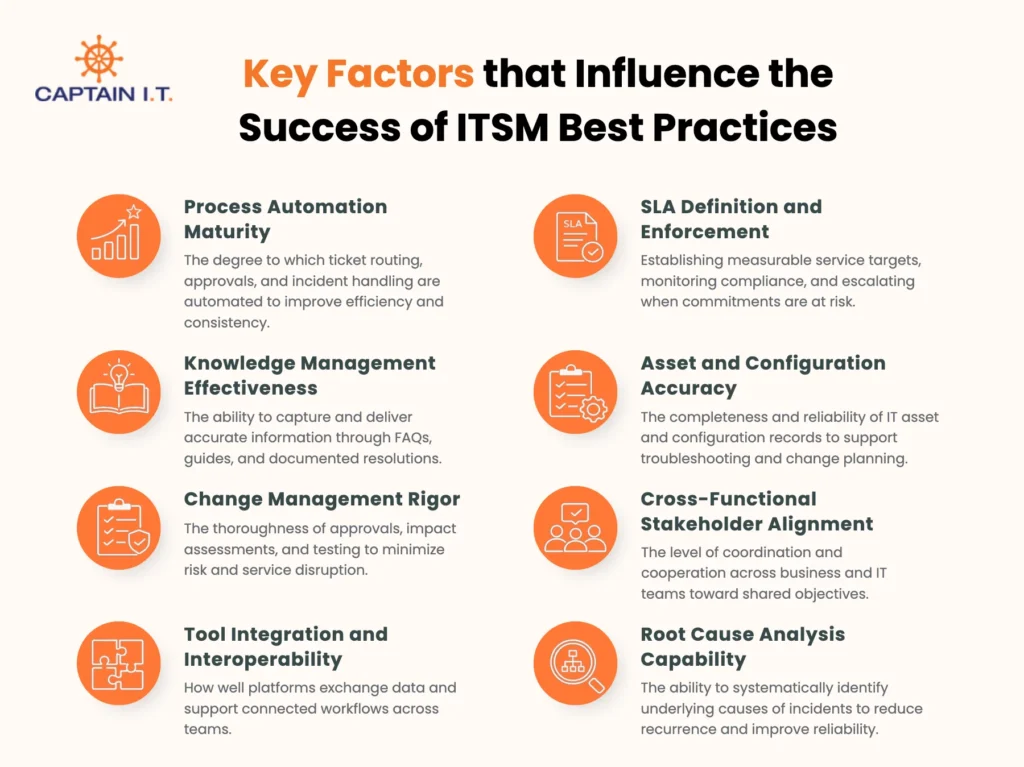
The factors that influence the success of ITSM best practices include process automation, effective knowledge management, strong change management, integrated ITSM tools, well-defined SLAs, accurate asset and configuration data, stakeholder alignment, and effective root cause analysis. Together, these components help businesses improve service quality, reduce operational inefficiencies, and maintain consistent IT service delivery, whether they run ITSM in-house or through managed IT solutions.
Key factors that influence the success of ITSM best practices are:
- Process Automation Maturity: Faster service delivery and fewer operational errors depend heavily on the maturity of process automation within ITSM. Process automation maturity refers to the extent to which tasks such as ticket routing, approvals, and incident handling are automated, improving consistency, scalability, and operational efficiency.
- Knowledge Management Effectiveness: The success of ITSM best practices relies heavily on how quickly users and support teams can access accurate information. Knowledge management effectiveness reflects the ability to capture, organize, and deliver relevant knowledge through resources such as FAQs, troubleshooting guides, and documented resolutions.
- Change Management Rigor: Consistent ITSM outcomes require changes to be implemented with minimal risk and disruption. Change management rigor refers to the thoroughness of approval workflows, impact assessments, testing procedures, and post-implementation reviews that help maintain service stability.
- Tool Integration and Interoperability: Effective ITSM processes depend on seamless data flow across service management tools and operational systems. Tool integration and interoperability describe how well platforms exchange information, synchronize data, and support connected workflows across teams.
- Sla Definition and Enforcement: Consistent service performance and greater accountability are ITSM outcomes driven by clearly defined and enforced SLAs. SLA definition and enforcement involve establishing measurable service targets, monitoring compliance, and managing escalations when commitments are at risk.
- Asset and Configuration Accuracy: Accurate asset and configuration data enable ITSM best practices to support effective troubleshooting, change planning, and risk management. Asset and configuration accuracy refers to the completeness, reliability, and auditability of IT asset and configuration records.
- Cross-Functional Stakeholder Alignment: Strong collaboration between business and IT teams improves the success of ITSM best practices by supporting shared objectives and better decision-making. Cross-functional stakeholder alignment refers to the degree of communication, coordination, and cooperation across departments involved in service delivery.
- Root Cause Analysis Capability: Effective root cause analysis strengthens ITSM best practices by reducing recurring incidents and improving long-term service reliability. Root cause analysis capability refers to the ability to investigate issues systematically and identify their underlying causes.