The top benefits of a disaster recovery plan include reducing downtime, limiting financial losses, preventing permanent data loss, protecting sensitive information, supporting regulatory compliance, strengthening risk management, maintaining customer trust, and ensuring business continuity during unexpected disruptions. These advantages help businesses recover critical IT systems more quickly, maintain operational stability, and reduce the impact of cyberattacks, hardware failures, natural disasters, and other incidents that threaten day-to-day operations.
For small and mid-sized businesses (SMBs), even a short outage can disrupt revenue, customer relationships, and productivity, making disaster recovery planning an important part of long-term business resilience. Partnering with an experienced Managed Service Provider (MSP) gives organizations access to managed backup, recovery testing, continuous monitoring, and rapid system restoration without the need to maintain a large internal IT team. Whether supporting startups, small businesses, large enterprises, or local organizations, disaster recovery planning helps businesses recover confidently, adapt to disruptions, and sustain long-term growth.
The top 10 benefits of a disaster recovery plan for your business are:
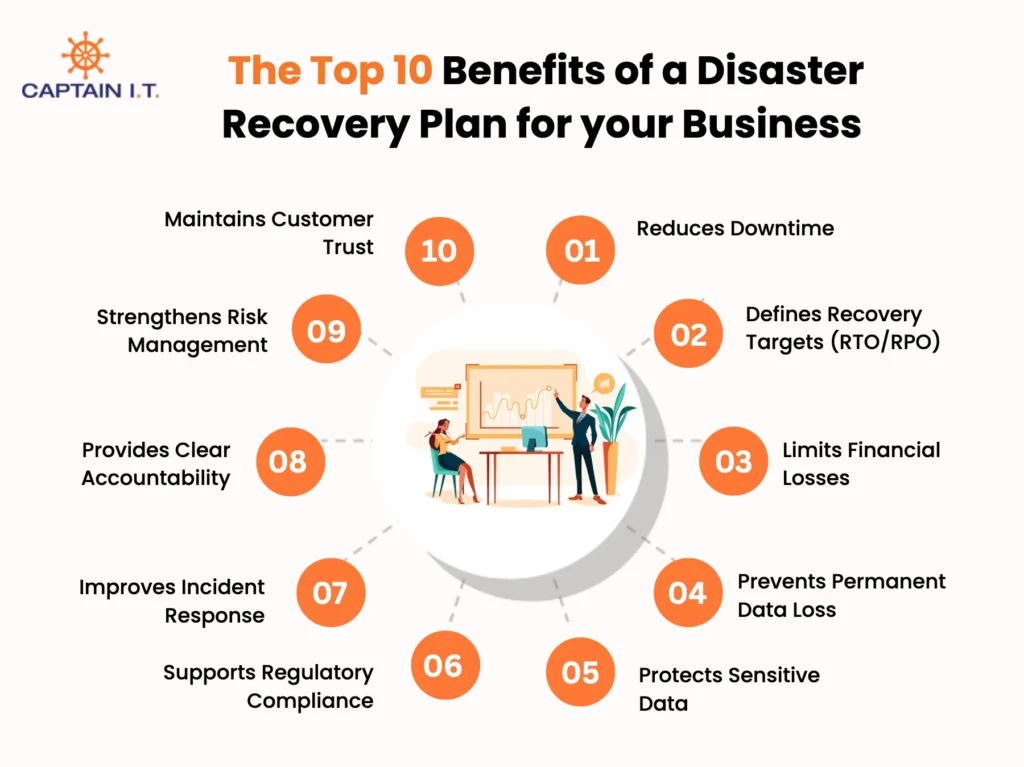
- Reduces Downtime
- Defines Recovery Targets (RTO/RPO)
- Limits Financial Losses
- Prevents Permanent Data Loss
- Protects Sensitive Data
- Supports Regulatory Compliance
- Improves Incident Response
- Provides Clear Accountability
- Strengthens Risk Management
- Maintains Customer Trust
Reduces Downtime
A disaster recovery plan reduces downtime for SMBs by quickly restoring critical IT systems, minimizing financial losses, and safeguarding sensitive data after unexpected disruptions. Predefined recovery procedures, automated runbooks, tested failover processes, and documented workflows enable SMBs to resume essential operations within minutes instead of days. Faster recovery keeps employees productive, maintains customer service, protects revenue, and reduces operational disruption.
Recovery Time Objective (RTO) defines the maximum acceptable downtime, while Recovery Point Objective (RPO) specifies acceptable data loss measured in time. Together, these targets help organizations prioritize recovery investments, measure preparedness, improve decision-making, strengthen business continuity, support consistent testing, accelerate restoration, simplify compliance, increase stakeholder confidence, guide risk management, and improve long-term operational resilience through well-tested recovery strategies aligned with business objectives and evolving organizational requirements during every significant outage event effectively.
Defines Recovery Targets (RTO/RPO)
Clearly defined Recovery Time Objective (RTO) and Recovery Point Objective (RPO) help SMBs establish measurable recovery targets that guide system restoration after disruptions. RTO specifies the maximum acceptable downtime before business operations are significantly affected, while RPO defines the maximum acceptable amount of data loss measured in time. Together, these metrics help SMBs determine backup frequency, prioritize critical workloads, and create cost-effective recovery strategies aligned with their operational requirements and available IT resources.
Global research from Veeam’s Data Protection Trends Report highlights a critical readiness gap, revealing that 85% of organizations admit to an operational availability gap between their stated RTO and RPO targets and IT’s actual capacity to achieve them during an outage. Regular testing, realistic recovery planning, and continuous infrastructure improvements help close this gap, strengthen business continuity, improve operational resilience, and ensure recovery objectives remain achievable under real-world disaster conditions.
Limits Financial Losses
For SMBs, prolonged outages can quickly lead to lost revenue, reduced productivity, and unexpected recovery expenses. Financial losses often stem from inaccessible data and delayed recovery efforts that interrupt business operations. Documented recovery procedures, secure backups, predefined recovery teams, and tested restoration processes enable SMBs to restore critical systems quickly, protect revenue, limit operational disruption, and maintain financial stability during unexpected incidents.
According to IBM’s 2023 Cost of a Data Breach Report, the average cost of a data breach reached USD 4.45 million, reflecting a 15% increase over three years. Organizations without tested disaster recovery strategies face higher recovery costs, regulatory penalties, reputational damage, and extended service outages. Investing in recovery planning helps reduce financial exposure, strengthen business continuity, and improve long-term organizational resilience.
Prevents Permanent Data Loss
Preventing permanent data loss requires a structured backup and recovery plan that protects the information of small and mid-sized businesses before, during, and after unexpected disruptions. Scheduled backups capture recent data changes, while offsite or cloud-based storage keeps recovery copies for SMBs separate from production environments. Regular testing verifies that backup systems restore applications and files accurately, reducing the risk of accidental deletion, hardware failure, cyberattacks, or natural disasters.
The growing sophistication of ransomware attacks makes backup security equally important as backup availability. Backup repositories are targeted in 96% of ransomware attacks, and attackers successfully compromise them 76% of the time ( source: SC Media). Protecting backups with immutable storage, encryption, strict access controls, and routine recovery testing preserves data integrity, strengthens business continuity, improves confidence in recovery, and ensures critical information remains available during high-impact incidents without permanent data loss.
Protects Sensitive Data
Protecting sensitive data requires layered security controls that help SMBs prevent unauthorized access during backup, storage, and recovery operations. Multi-factor authentication restricts backup access to authorized personnel, while end-to-end encryption safeguards stored information even if backup repositories are compromised. Combined with secure backup procedures and controlled recovery workflows, these measures preserve data confidentiality, integrity, and availability throughout the recovery lifecycle.
Meeting regulatory requirements depends on maintaining secure disaster recovery processes alongside effective data protection. Standards such as HIPAA, GDPR, and SOC 2 require organizations to implement documented backup procedures, recovery protocols, and technical safeguards that protect sensitive information. Strong access controls, encryption, and secure recovery practices simplify compliance, reduce breach risks, strengthen business continuity, and ensure critical business and customer data remains protected during disruptive incidents.
Supports Regulatory Compliance
A disaster recovery plan helps small and mid-sized businesses support regulatory compliance by establishing documented procedures for protecting, backing up, restoring, and monitoring critical data throughout its lifecycle. Recovery plans maintain detailed records of backup activities, recovery objectives, testing results, and incident response actions, providing the evidence auditors need to verify compliance with standards such as HIPAA, PCI DSS, and GDPR. This structured documentation improves governance, simplifies audits, and demonstrates consistent adherence to data protection requirements.
Failure to comply with regulatory requirements can lead to substantial financial penalties, legal consequences, and reputational damage. According to Tulane University, documented disaster recovery plans simplify audits by providing clear evidence of recovery objectives and response procedures. Many cyber insurance providers also require a written disaster recovery plan before issuing coverage, making disaster recovery planning an important part of business continuity, compliance, and organizational resilience.
Improves Incident Response
Improved incident response begins with clearly documented recovery procedures that guide technical restoration, infrastructure recovery, and data protection after a security event is contained. Preplanned failovers, defined team responsibilities, scheduled backups, and regularly tested recovery processes enable SMBs to restore critical systems quickly while maintaining data integrity. Coordinated response workflows reduce confusion, accelerate decision-making, and minimize operational disruption during cyberattacks, hardware failures, or other unexpected incidents.
According to IBM and the Ponemon Institute’s Cost of a Data Breach report, organizations with formal incident response plans, regular testing, and dedicated response teams contain breaches an average of 54 days faster than those without them. Combining incident response with disaster recovery planning strengthens business continuity, reduces downtime, protects critical systems, and enables faster restoration of normal business operations.
Provides Clear Accountability
By assigning defined roles, responsibilities, and decision-making authority before disruptions occur, disaster recovery plans provide SMBs with clear accountability. A documented chain of command identifies who manages system restoration, stakeholder communication, backup recovery, and infrastructure restoration, eliminating uncertainty during critical situations. Clear ownership prevents duplicated efforts, reduces missed recovery tasks, streamlines coordination across departments, and ensures every recovery activity is completed by the appropriate team or individual.
Structured accountability also creates reliable audit trails by documenting recovery actions, assigned responsibilities, and post-incident decisions. According to Colorado Resiliency, reviewing recovery performance after an incident helps organizations identify process improvements and strengthen future response plans. Defined ownership, documented responsibilities, and continuous evaluation accelerate recovery, improve operational resilience, support regulatory compliance, and strengthen business continuity by ensuring every recovery decision remains organized, traceable, and consistently executed.
Strengthens Risk Management
Disaster recovery plans strengthen risk management for SMBs by identifying critical business systems, assessing potential threats, and prioritizing recovery strategies before disruptions occur. Risk assessments help organizations determine which applications, data, and infrastructure require immediate protection, while preventive controls such as secure backups, offsite storage, and network security measures reduce the likelihood of cyberattacks, hardware failures, and natural disasters disrupting operations. This proactive approach enables informed decision-making and improves organizational preparedness.
Regular testing and continuous updates ensure recovery procedures remain aligned with evolving technologies, business processes, and emerging threats. Validating recovery plans through simulations helps organizations identify weaknesses, refine response strategies, reduce operational risks, strengthen business continuity, improve resilience, and minimize the overall impact of unexpected incidents on critical business operations and services.
Maintains Customer Trust
SMBs can maintain customer trust by implementing disaster recovery plans that restore operations quickly, protect sensitive information, and communicate clearly during crises. Rapid recovery minimizes service interruptions, allowing small and mid-sized businesses to continue delivering products or services with minimal impact. Timely updates on outage status, recovery progress, and expected resolution demonstrate accountability, reassure customers, and reinforce confidence in the organization’s ability to respond effectively during incidents.
Service disruptions can quickly damage customer confidence and long-term brand loyalty. According to the PagerDuty Global Customer Incidents Survey, 90% of IT leaders report that outages have reduced customer trust. Businesses that invest in tested disaster recovery plans are better positioned to maintain reliable service, safeguard customer relationships, protect brand reputation, and strengthen business continuity by consistently meeting customer expectations during operational disruptions.
What Are the Benefits of a Disaster Recovery Plan for Startups?
The benefits of a disaster recovery plan for startups include protecting limited financial resources, strengthening investor confidence, enabling lean teams to recover quickly, preserving customer trust, and supporting business agility without data loss. According to the U.S. Bureau of Labor Statistics, roughly 20.4% of new businesses fail within their first year, and 49.4% close within five years. Although startups fail for many reasons, downtime and data loss can intensify financial and operational challenges. Partnering with an MSP helps startups strengthen resilience while controlling IT costs.
5 benefits of a disaster recovery plan for startups are:
- Protects Limited Runway From Failures
A disaster recovery plan protects a startup’s financial runway by reducing downtime, preventing costly data loss, and restoring critical systems quickly after disruptions. Cloud-based backups, automated recovery, and predefined response procedures minimize operational interruptions and unexpected expenses. For startups with limited technical resources, an MSP can deliver managed disaster recovery services that protect business continuity while controlling infrastructure and recovery costs.
- Builds Investor Confidence
Documented disaster recovery procedures demonstrate that a startup has planned for operational risks and business continuity. Investors value organizations that can protect critical systems, customer data, and ongoing operations during unexpected events. Recovery planning, regular testing, and managed IT support show operational maturity, increasing confidence during funding rounds, due diligence reviews, and long-term growth discussions.
- Enables Lean Teams to Recover Fast
Lean startup teams benefit from predefined recovery workflows that eliminate uncertainty during outages. Clearly assigned responsibilities, automated backups, and tested recovery procedures enable employees to restore operations quickly without extensive technical expertise. An MSP further supports lean teams by monitoring systems, managing backups, and coordinating recovery activities, allowing employees to remain focused on business growth.
- Protects Early Reputation and Trust
Early customer relationships are difficult to rebuild after service disruptions or data loss. Disaster recovery planning helps startups restore services quickly, protect customer information, and communicate transparently throughout recovery efforts. Consistent service availability demonstrates reliability, strengthens customer confidence, and helps emerging businesses establish a positive reputation as they compete with larger, more established organizations.
- Supports Fast Pivots Without Data Loss
Startups often adapt products, platforms, or business models as market conditions change. Disaster recovery planning supports these transitions by protecting business data through automated backups, secure cloud storage, and rapid restoration processes. Managed recovery services also enable startups to migrate workloads, recover applications, and continue operations with minimal disruption, preserving business agility without compromising critical information.
What Are the Benefits of a Disaster Recovery Plan for Small Businesses?
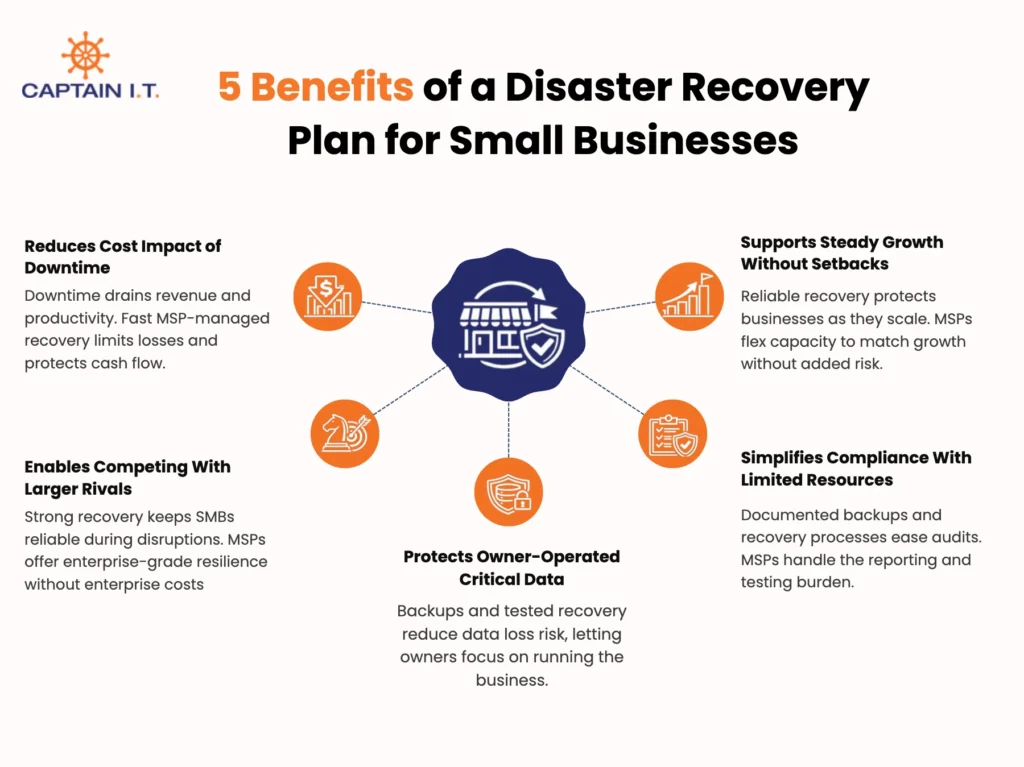
The benefits of a disaster recovery plan for small businesses include reducing the financial impact of downtime, improving competitiveness, protecting business-critical data, simplifying compliance, and supporting sustainable growth. Up to 40% of small businesses never reopen after a disaster(source: Federal Emergency Management Agency (FEMA)). Disaster recovery planning reduces this risk by enabling faster restoration of critical systems and data. For SMBs with limited IT resources, partnering with an MSP provides cost-effective backup, disaster recovery, and business continuity solutions.
Below are the 5 benefits of a disaster recovery plan for small businesses:
- Reduces Cost Impact of Downtime
Reducing downtime helps small businesses avoid lost revenue, employee idle time, emergency repair costs, and customer dissatisfaction. Rapid system recovery keeps operations running while minimizing business interruptions and protecting cash flow. According to Keiser University, business continuity and disaster recovery planning reduce the operational impact of unexpected outages. Managed recovery services from an MSP further shorten recovery times and lower overall recovery costs.
- Enables Competing With Larger Rivals
Reliable disaster recovery enables small businesses to deliver consistent service even when unexpected disruptions occur. Faster recovery, secure data protection, and continuous system availability help SMBs meet customer expectations and compete with larger organizations. Partnering with an MSP provides enterprise-grade recovery capabilities, allowing smaller businesses to improve resilience without investing in complex infrastructure or dedicated recovery teams.
- Protects Owner-Operated Critical Data
Business records, financial documents, customer information, and operational data are valuable assets for owner-operated businesses. Disaster recovery planning protects this information through automated backups, secure storage, and tested recovery procedures that reduce the risk of permanent data loss. Managed backup and recovery services also help business owners restore critical systems quickly while focusing on serving customers and daily operations.
- Simplifies Compliance With Limited Resources
Meeting regulatory requirements becomes easier when disaster recovery procedures, backup schedules, and recovery activities are properly documented. Small businesses with limited internal IT resources benefit from structured recovery processes that support audit readiness and data protection obligations. An MSP can manage compliance-related backups, recovery testing, and reporting, helping SMBs maintain regulatory standards while reducing administrative workload.
- Supports Steady Growth Without Setbacks
Business growth depends on reliable technology that can recover quickly from unexpected disruptions. Disaster recovery planning protects expanding operations by minimizing downtime, safeguarding business data, and maintaining service continuity during infrastructure changes or system failures. As SMBs scale, an MSP can adapt backup capacity, recovery infrastructure, and monitoring services to support long-term growth without increasing operational complexity or business risk.
What Are the Benefits of a Disaster Recovery Plan for Large Enterprises?
The benefits of a disaster recovery plan for large enterprises include maintaining business continuity across multiple locations, meeting complex compliance requirements, protecting interconnected systems, coordinating large-scale recovery efforts, and safeguarding brand reputation. IBM’s Cost of a Data Breach Report found that the average data breach cost reached USD 4.88 million, highlighting the financial impact of cyber incidents and prolonged downtime. An experienced MSP helps enterprises automate recovery, reduce downtime, strengthen resilience, and maintain uninterrupted business operations.
5 key benefits of a disaster recovery plan for large enterprises are:
- Ensures Business Continuity Across Locations
Standardized recovery procedures enable large enterprises to restore operations consistently across regional offices, data centers, and cloud environments. Coordinated failover processes minimize downtime while allowing unaffected locations to continue supporting customers. An enterprise MSP can orchestrate multi-site disaster recovery, monitor infrastructure continuously, and manage recovery activities to maintain uninterrupted business operations during large-scale disruptions.
- Meets Strict Compliance and Audit Demands
Large enterprises must maintain detailed recovery documentation, audit logs, and tested recovery procedures to satisfy industry regulations and internal governance requirements. Disaster recovery planning simplifies audits by providing verifiable evidence of data protection and recovery readiness. MSPs also help enterprises automate compliance reporting, conduct recovery testing, and maintain documentation that supports evolving regulatory obligations.
- Protects Complex, Interconnected Systems
Enterprise applications depend on interconnected databases, networks, cloud platforms, and business services that must recover in the correct sequence. Disaster recovery planning maps system dependencies, prioritizes critical workloads, and prevents cascading failures across integrated environments. Experienced MSPs coordinate application recovery, infrastructure restoration, and cloud failovers to reduce operational disruption and maintain system availability.
- Coordinates Response Across Large Teams
Successful enterprise recovery depends on clearly defined responsibilities, communication protocols, and coordinated decision-making across multiple departments. Disaster recovery plans establish structured workflows that align IT, security, operations, and executive leadership throughout the recovery process. Regular recovery exercises and MSP-led incident coordination improve collaboration, reduce confusion, and accelerate restoration during complex business disruptions.
- Safeguards Brand Reputation at Scale
Enterprise outages can quickly affect customers, partners, regulators, and shareholders across multiple markets. Disaster recovery planning minimizes service interruptions, protects sensitive business information, and supports transparent communication throughout recovery efforts. Reliable recovery capabilities strengthen stakeholder confidence, preserve brand reputation, and demonstrate operational resilience while helping enterprises maintain business continuity during high-impact incidents.
What Are the Benefits of a Disaster Recovery Plan for Local Businesses?
The benefits of a disaster recovery plan for local businesses include protecting operations from local disasters, restoring customer-facing services quickly, preserving community trust, enabling continuity with limited IT resources, and maintaining operations without relocating. Local SMBs often rely on continuous customer interactions and cannot afford prolonged downtime. Investing in professional disaster recovery services helps businesses implement managed backup, rapid recovery, and business continuity strategies that strengthen resilience without requiring extensive in-house IT expertise.
5 core benefits of a disaster recovery plan for local businesses are:
- Protects Against Local Disasters and Outages
Local businesses face disruptions from power outages, severe weather, fires, hardware failures, and cyberattacks that can interrupt daily operations. Disaster recovery planning minimizes operational disruption through secure backups, documented recovery procedures, and rapid system restoration. An MSP can further strengthen resilience by providing continuous monitoring, cloud-based recovery, and proactive support that helps businesses recover quickly from local incidents.
- Ensures Quick Recovery for Foot-Traffic Revenue
Retail stores, restaurants, medical clinics, and service businesses depend on daily customer traffic to generate revenue. Disaster recovery planning restores payment systems, business applications, and critical infrastructure quickly, minimizing lost sales and customer inconvenience. Managed recovery services also help local businesses reopen faster after unexpected outages, protecting daily revenue and maintaining consistent customer service.
- Safeguards Community Trust and Reputation
Reliable service recovery demonstrates preparedness and reinforces confidence among customers, partners, and the local community. Rapid restoration of business operations, transparent communication, and secure protection of customer information help preserve long-term relationships during disruptive events. Businesses supported by an MSP can respond more effectively to outages while maintaining the dependable service customers expect.
- Enables Continuity With Limited IT Resources
Many local businesses operate without dedicated IT departments, making disaster recovery difficult to manage internally. Cloud-based backups, automated recovery, and documented response procedures simplify restoration and reduce operational complexity. An MSP manages recovery testing, backup monitoring, and system restoration, allowing business owners and employees to remain focused on serving customers instead of resolving technical issues.
- Supports Recovery Without Relocating Operations
Remote access technologies, cloud infrastructure, and virtual collaboration tools allow local businesses to continue operating even when physical locations become temporarily inaccessible. Disaster recovery planning minimizes business interruption by restoring access to applications and critical data from alternate locations. MSP-managed cloud recovery solutions further support uninterrupted operations while reducing recovery time and avoiding costly business relocation.