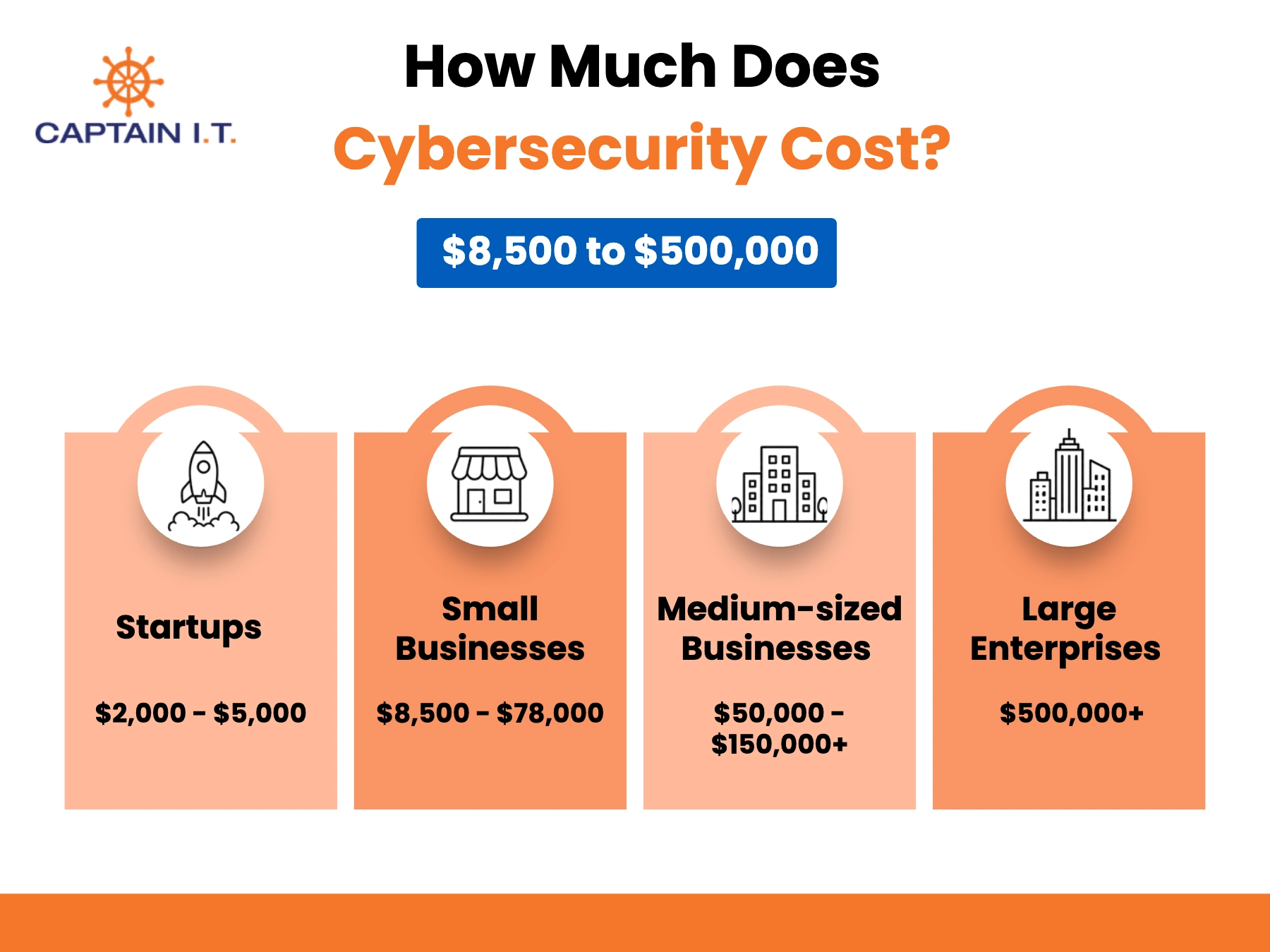
Cybersecurity costs range from $8,500 to $500,000, depending on business size, security requirements, risk exposure, regulatory compliance needs, and the level of protection implemented. Startups spend $2,000 to $5,000 on risk assessments and $2,000 to $3,500 per month on managed security services, while small businesses invest $8,500 to $78,000 annually. Medium-sized businesses allocate $50,000 to $ 150,000 or more per year. Large enterprises often maintain cybersecurity budgets exceeding $500,000 annually to support advanced security operations, regulatory compliance, and continuous threat monitoring.
Beyond business size, cybersecurity price also depends on the services and protection levels required. Businesses often invest in risk assessments, security audits, incident response, managed security services, MDR, SOC monitoring, vCISO support, cyber insurance, security awareness training, consulting, and cybersecurity software. Service providers use hourly, monthly, per-user, project-based, and flat-rate pricing models to align costs with business needs. Industry requirements further influence spending, with construction, healthcare, and manufacturing businesses often investing more in cybersecurity due to compliance demands, sensitive data, and higher cyber risks.
Do Cybersecurity Costs Differ By Business Size?
Yes, cybersecurity costs differ by business size, with startups spending $2,000 to $5,000 on initial security assessments, small businesses investing $8,500 to $78,000 annually, medium businesses allocating $50,000 to $150,000+or more per year, and large enterprises spending more than $500,000 per month on comprehensive cybersecurity programs. Factors such as employee count, IT infrastructure complexity, regulatory compliance requirements, data volume, and overall risk exposure significantly influence cybersecurity costs across organizations.
How Much Does Cybersecurity Cost for Startups?
Cybersecurity costs for startups range from $2,000 to $5,000 for an initial risk assessment and $2,000 to $3,500 per month for managed cybersecurity services. Many startups use managed security providers for network monitoring, endpoint protection, threat detection, and incident response instead of maintaining an in-house security team. Most organizations allocate 7% to 12% of their IT budget to cybersecurity to reduce the risk of data breaches, ransomware attacks, and other cyber threats while supporting business growth and operational continuity.
How Much Does Cybersecurity Cost for Small Businesses?
Cybersecurity costs for small businesses range from $8,500 to $78,000 annually, depending on the business size, industry, regulatory requirements, IT environment, and the level of cybersecurity protection required. Many businesses allocate 7% to 12% of their IT budget to cybersecurity, although regulated industries such as healthcare and finance may spend up to 25%. Managed cybersecurity services cost $2,000 to $3,500 per month and can include threat monitoring, incident response, endpoint protection, and vulnerability management to reduce cyber risks and protect business operations.
How Much Does Cybersecurity Cost for Medium Businesses?
Cybersecurity costs for medium businesses range from $50,000 to $ 150,000+ annually, depending on the size of the IT environment, regulatory requirements, and the number of users, devices, and business applications that require protection. Managed cybersecurity services cost $2,000 to $3,500 per month, while preventive measures such as vulnerability assessments, employee training, and security software can add $5,000 to $15,000 per year. These investments help reduce the risk of cyber incidents, which can cost medium-sized businesses more than $500,000 in recovery, legal, compliance, and operational expenses.
How Much Does Cybersecurity Cost for Large Enterprises?
Cybersecurity costs for large enterprises can exceed $500,000 per month, depending on the organization’s size, regulatory requirements, and risk exposure. These budgets often cover advanced threat detection, security operations center (SOC) services, incident response, compliance management, and continuous monitoring across complex IT environments. Large organizations in sectors such as finance and healthcare also spend $7,000 or more annually on cyber insurance. Higher costs are driven by the need to protect sensitive data, secure thousands of users and devices, and reduce the financial impact of cyberattacks, regulatory penalties, and operational disruptions.
What Is the Average Cost of Cybersecurity?
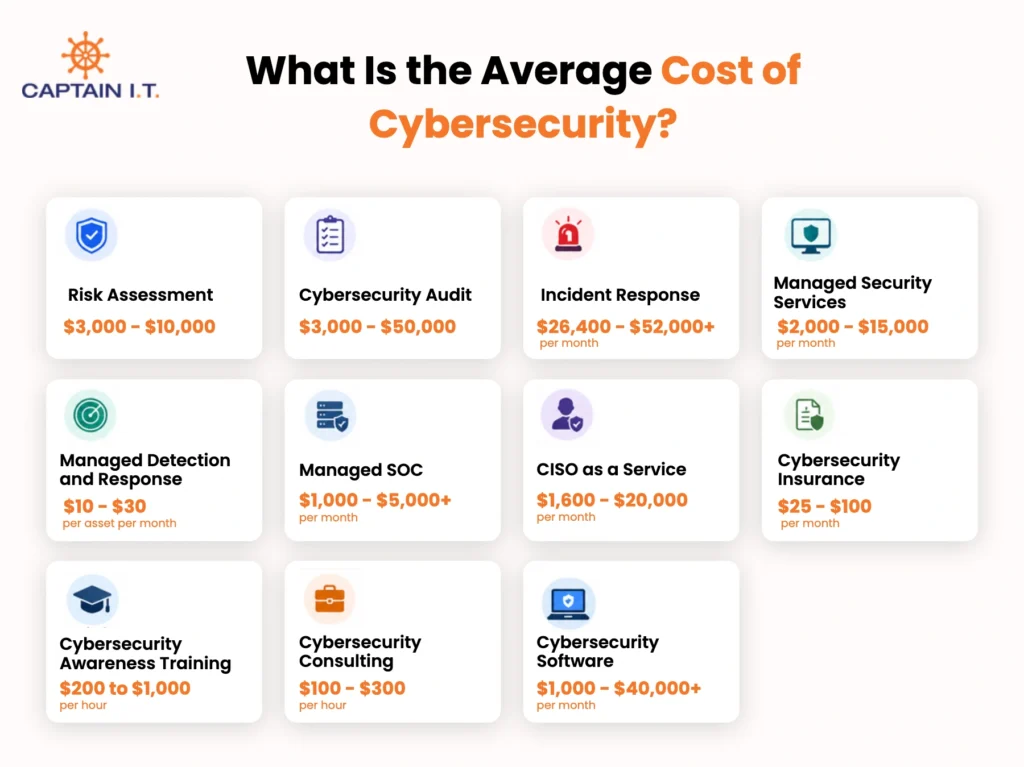
The average cost of cybersecurity ranges from $50,000 to $250,000 annually, depending on business size, security requirements, regulatory compliance, risk exposure, and the level of cybersecurity protection implemented. Cybersecurity service costs vary widely, with risk assessments costing $3,000 to $50,000+, audits $3,000 to $100,000+, managed security services $2,000 to $20,000+ per month, and cybersecurity software from $1,000 per month to $500,000+ annually. Costs depend on the service type, business size, compliance requirements, and security needs.
How Much Does Cybersecurity Risk Assessment Cost?
Cybersecurity risk assessment costs range from $3,000 to $10,000 for small businesses, $10,000 to $50,000 for mid-sized businesses, and start at $15,000 for enterprise organizations, depending on the scope, complexity, and number of users. Some providers also charge around $5,000 per day for cybersecurity consultants or use device-based pricing models. The final price is influenced by factors such as network size, regulatory requirements, asset volume, and the depth of testing needed to identify security risks and vulnerabilities.
How Much Does a Cybersecurity Audit Cost?
Cybersecurity audit costs range from $3,000 to $50,000, with small businesses (1-50 employees) spending $3,000 to $15,000 and medium-sized organizations (51-250 employees) paying $15,000 to $40,000. SOC 2 audits start at $15,000 and can exceed $100,000 for larger or more complex environments. Additional services, such as vulnerability scanning and penetration testing, can increase the price, with penetration testing often starting at $3,000. Factors including business size, audit scope, compliance requirements, and provider expertise significantly influence the final price.
How Much Does Incident Response Cost?
Incident response services cost $26,400 to $52,000+ per month, depending on the required level of expertise, the number of hours needed, and the complexity of the security incident. On an hourly basis, incident response analysts charge from $165 per hour, while digital forensic specialists generally charge $325 or more per hour. Organizations often require both analysts and forensic specialists to investigate ransomware attacks, data breaches, and other security events, which can quickly increase the overall price. Complex incident response investigations can exceed $150,000. Some managed cybersecurity providers also include up to $50,000 in incident cost coverage. Final costs depend on the attack type, recovery scope, and forensic analysis required.
How Much Does Managed Security Services Cost?
Managed security services cost $2,000 to $15,000 per month for most small and medium-sized businesses, and $20,000 or more per month for organizations with complex security needs. Providers often charge $50 to $200+ per user per month or $2.50 to $250 per endpoint per month. Pricing depends on the number of users, endpoints, compliance requirements, and security services included. Common services include threat monitoring, endpoint protection, incident response, vulnerability management, and multi-factor authentication management.
How Much Does Managed Detection and Response Cost?
Managed Detection and Response (MDR) costs $10 to $30 per asset per month, with annual expenses ranging from $15,000 to $60,000 for smaller environments and $50,000 to $300,000 or more for larger organizations. MDR services provide continuous threat monitoring, detection, and incident response to help organizations identify and contain cyber threats. Pricing depends on factors such as the number of assets covered, the scope of protection, organizational requirements, and the complexity of the existing security infrastructure.
How Much Does Managed SOC Cost?
Managed SOC services cost $1,000 to $5,000+ per month, with pricing often based on the number of users or endpoints to be protected. These services include security technologies such as EDR, XDR, SIEM, and ITDR, as well as 24/7 security monitoring and threat response. For organizations with more than 500 endpoints, costs can reach $50 per endpoint per month. Managed SOC services provide a more cost-effective alternative to building an in-house SOC, which can cost more than $1 million annually due to staffing, technology, and infrastructure requirements.
How Much Does CISO as a Service Cost?
CISO as a Service (vCISO) costs $1,600 to $20,000 per month, with hourly rates ranging from $150 to $400+ and project-based engagements costing $5,000 to $50,000. A vCISO provides strategic cybersecurity leadership, risk management, compliance guidance, and security program oversight without the expense of hiring a full-time executive. Compared to a traditional CISO salary of $200,000 to $500,000 per year, a vCISO can reduce costs by 70% to 80% while giving organizations access to experienced cybersecurity expertise on a flexible basis.
How Much Does Cybersecurity Insurance Cost?
Cybersecurity insurance costs range from $25 to $100 per month for personal coverage and $500 to more than $120,000 annually for businesses, depending on coverage limits and risk exposure. Small businesses pay an average of $129 per month, or about $1,500+ per year, while many organizations spend $1,200 to $7,000 annually, with a median cost of approximately $2,000 per year. Premiums are influenced by factors such as company size, industry, revenue, claims history, data sensitivity, and the strength of existing cybersecurity controls.
How Much Does Cybersecurity Awareness Training Cost?
Cybersecurity awareness training costs $200 to $1,000 per month for organizations, depending on the number of employees and the training program selected. Some providers offer basic training programs for as little as $0.45 to $1.25 per user per month, while comprehensive enterprise-wide training initiatives can cost $10,000 or more annually. Specialized cybersecurity courses, such as those offered by SANS, often cost $6,000 to $7,000 per course, and cybersecurity boot camps range from $5,000 to $15,000. Pricing depends on the number of employees, training frequency, content depth, compliance requirements, and program customization.
How Much Does Cybersecurity Consulting Cost?
Cybersecurity consulting costs range from $100 to $300 per hour for most consultants, while specialized experts charge $75 to $800 per hour depending on their experience and the complexity of the engagement. Freelance cybersecurity consultants charge an average of $144 per hour, and project-based engagements often cost $8,000 to $10,000 for a standard 40-hour project. Businesses seeking ongoing cybersecurity support can expect managed consulting services to start at $2,000 to $3,500 per month. Costs vary based on project scope, business size, security requirements, and the level of expertise required.
How Much Does Cybersecurity Software Cost?
Cybersecurity software costs $1,000 to $40,000+ per month, depending on the number of users, devices, and security solutions deployed. Small and medium-sized businesses spend around $1,000 per month on cybersecurity software, while large enterprises can spend more than $500,000 annually. Outsourced cybersecurity services for SMBs start at $1,000 to $3,500 per month, with per-user pricing from $195 to $350 per month and per-device pricing from $50 to $100 per month. For example, a business with 20 employees spends $3,900 to $7,000 per month, while an organization managing 50 devices spends $2,500 to $5,000 per month. Factors such as business size, compliance requirements, and the scope of security services influence overall costs.
How Much to Charge for Cybersecurity Services?
Cybersecurity service pricing varies by model, with hourly rates ranging from $100 to $149 per hour, monthly rates starting around $1,000 and reaching $2,000 to $3,500 for managed services, per-user pricing ranging from $100+ to $350 per user per month, project-based pricing averaging $8,000 to $10,000 per engagement, and flat-rate monthly plans starting at $2,000 to $3,500 per month for ongoing protection. The most suitable pricing model depends on factors such as business size, security requirements, compliance obligations, and the level of ongoing cybersecurity support needed.
- Hourly Rate
Cybersecurity providers charge $100 to $149 per hour, while specialized consultants and advanced security experts may charge $75 to $800 per hour, depending on their expertise and the complexity of the engagement. This model is often used for consulting, incident response, security assessments, and advisory services.
- Monthly Rate
Monthly cybersecurity services cost around $1,000 per month for basic protection, while managed cybersecurity services start at $2,000 to $3,500 per month. Monthly pricing is used for ongoing security monitoring, threat detection, vulnerability management, and incident response support.
- Per-User Pricing
Per-user cybersecurity pricing ranges from $100+ to $350 per user per month, while comprehensive cybersecurity protection costs approximately $2,500 to $2,800 per employee annually. This model allows organizations to align security costs directly with workforce size and is used for managed security services and endpoint protection.
- Project-Based Pricing
Project-based cybersecurity services cost $8,000 to $10,000 for a standard engagement, such as a risk assessment, penetration test, compliance audit, or security implementation project. Final costs depend on the project’s scope, objectives, and technical complexity.
- Flat-Rate Monthly Pricing
Flat-rate cybersecurity services start at $2,000 to $3,500 per month and provide ongoing protection for a fixed monthly fee. These plans often include network monitoring, endpoint security, threat detection, and incident response, giving organizations predictable cybersecurity costs regardless of the number of incidents or support hours required.
How Does Industry Impact Cybersecurity Cost?
Industry impacts cybersecurity costs because construction companies often spend 8% to 15% of their IT budgets on cybersecurity, healthcare organizations allocate 5% to 15% due to strict compliance and high breach costs, while manufacturing companies invest 7% to 20% to protect operational systems and reduce the risk of costly cyber incidents. Factors such as regulatory requirements, data sensitivity, exposure to threats, and the financial impact of cyberattacks drive differences in cybersecurity spending across industries.
How Much Does Cybersecurity Cost for Construction Companies?
Cybersecurity costs for construction companies range from $2,000 to $3,500 per month,8% to 15% of the total IT budget, meaning a company with a $1 million IT budget spends $80,000 to $150,000 annually on cybersecurity. These investments help protect sensitive project data, employee information, and operational systems from cyber threats, including ransomware attacks, which have an average recovery cost of $5.08 million.
How Much Does Cybersecurity Cost for Healthcare Organizations?
Healthcare organizations typically budget $4,200 to $12,500 per month for cybersecurity, depending on their size, security requirements, and regulatory obligations. This represents approximately 5% to 15% of the IT budget, with a $1 million IT budget translating to $50,000 to $150,000 in annual cybersecurity spending. The investment helps safeguard patient data and reduce the financial impact of data breaches, which average $10.93 million in the healthcare sector.
How Much Does Cybersecurity Cost for Manufacturing Companies?
Cybersecurity costs for manufacturing companies often range from $2,000 to $3,500 per month to protect operational technology, production systems, and sensitive business data. Most organizations spend 7% to 20% of the IT budget, with small manufacturers spending approximately $8,500 per year and businesses with 11 to 50 employees investing around $25,400 annually. These investments help reduce the risk of cyber incidents, which cost manufacturers an average of $4.24 million per data breach.
What Factors Influence Cybersecurity Cost?
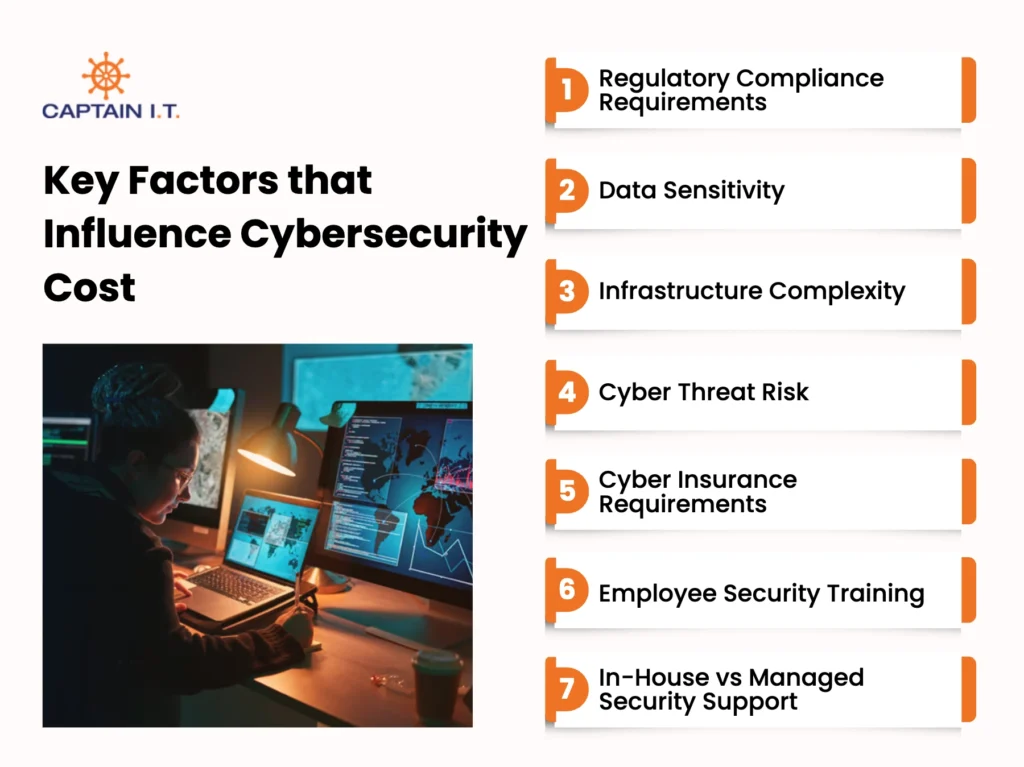
Several factors influence cybersecurity costs, including regulatory compliance requirements, data sensitivity, infrastructure complexity, cyber threat risk, cyber insurance requirements, employee security training, and the choice between in-house and managed security support. These components determine the level of security controls, monitoring, expertise, and compliance efforts required, directly affecting the overall cost of protecting an organization’s systems, data, and operations from cyber threats.
Key factors that influence cybersecurity cost include:
- Regulatory Compliance Requirements
Regulatory compliance requirements can increase cybersecurity costs by $5,000 to $100,000+ annually because organizations must implement specific security controls, audits, monitoring systems, and reporting processes. Industries subject to HIPAA, PCI DSS, GDPR, or CMMC invest more to meet compliance obligations and avoid fines or legal penalties.
- Data Sensitivity
The more sensitive the data an organization stores, processes, or transmits, the higher its cybersecurity costs, ranging from $5,000 to $100,000+.SMBs handling patient records, financial information, intellectual property, or customer data often invest in advanced encryption, access controls, data loss prevention tools, and continuous monitoring to reduce the risk of unauthorized access and data breaches.
- Infrastructure Complexity
Infrastructure complexity increases cybersecurity costs by $10,000 to $150,000+ annually because each additional system, application, cloud platform, or endpoint expands the environment that must be secured. SMBs operating hybrid networks, multiple locations, or large cloud environments require more security tools, monitoring resources, and technical expertise than businesses with simpler infrastructures.
- Cyber Threat Risk
Higher cyber threat exposure raises cybersecurity costs by $10,000 to $200,000+ annually, as organizations must invest in stronger defenses to prevent attacks and minimize potential losses. Businesses frequently targeted by ransomware, phishing campaigns, or data theft often allocate larger budgets to threat detection, incident response, security monitoring, and vulnerability management programs.
- Cyber Insurance Requirements
Cyber insurance requirements can introduce new cybersecurity expenses of $2,000 to $25,000+ annually, as many insurers require organizations to implement specific security measures before issuing coverage.SMBs often invest in multi-factor authentication, endpoint protection, backup systems, and security assessments to meet underwriting standards and qualify for coverage.
- Employee Security Training
Workforce size directly influences cybersecurity training costs, $20 to $120+ per employee annually, as most security awareness programs are priced per user. SMBs invest in employee training, phishing simulations, and compliance education to reduce the risk of costly breaches caused by human error and social engineering attacks.
- In-House vs Managed Security Support
Choosing an in-house security team instead of a managed security provider can increase annual cybersecurity costs by $100,000 to $ 500,000 or more due to staffing, salaries, benefits, training, and technology investments. In comparison, managed security services cost $2,000 to $20,000+ per month, making them a more cost-effective option for many SMBs.
How Much Should a Business Spend on Cybersecurity?
Businesses should allocate 7% to 20% of their total IT budget to cybersecurity, with small businesses often dedicating 10% to 15% to maintain adequate protection. As a general benchmark, small and medium-sized businesses spend $8,500 to $78,000 annually, or approximately $1,000 per month, on cybersecurity. This budget should cover security tools, continuous monitoring, cyber insurance, employee security training, and security personnel or managed security services. The exact amount depends on industry requirements, threat exposure, data sensitivity, and IT infrastructure complexity.
What Are the Risks of Cutting Cybersecurity Costs?
The risks of cutting cybersecurity costs include higher breach recovery costs, regulatory fines, reputational damage, weaker threat detection capabilities, and denied cyber insurance claims, all of which can result in greater financial losses and operational disruptions than the savings achieved by reducing security investments. SMBs that underinvest in cybersecurity often face greater exposure to ransomware attacks, data breaches, compliance violations, and prolonged downtime, which can significantly impact business performance and customer trust.
Below are the risks of cutting cybersecurity costs
- Higher Breach Recovery Costs: Cutting investments in preventive security controls, monitoring, and incident response can turn a manageable cyber incident into a costly recovery effort. SMBs often incur expenses for ransomware recovery, forensic investigations, legal services, data restoration, and operational downtime that far exceed the savings from reducing cybersecurity budgets.
- Regulatory Fines: Businesses subject to HIPAA, GDPR, PCI DSS, or similar regulations can face substantial fines, legal expenses, and remediation costs if inadequate cybersecurity controls contribute to a compliance failure or data breach. Reducing spending on compliance-related security measures increases the likelihood of regulatory violations.
- Reputational Damage: Scaling back cybersecurity protections increases the likelihood of public security incidents that can damage customer confidence. A single data breach or ransomware attack can negatively affect brand reputation, weaken customer relationships, and create long-term revenue losses that are difficult and expensive to reverse.
- Weaker Threat Detection: Eliminating or limiting the use of security monitoring tools reduces an organization’s ability to identify cyber threats before they cause damage. Without adequate visibility into networks, endpoints, and user activity, attackers can remain undetected longer, increasing the severity and cost of security incidents.
- Denied Cyber Insurance Claims: Cutting cybersecurity costs can jeopardize cyber insurance coverage by eliminating the security controls insurers require. Many providers require safeguards such as multi-factor authentication, endpoint protection, employee security training, and secure backups. Failure to meet these requirements can lead to denied claims, reduced coverage, or increased insurance costs.
Is Cybersecurity Cost Worth It?
Yes, cybersecurity costs are worth it because they help prevent expensive data breaches, reduce regulatory fines, limit business downtime, protect customer trust, and support cyber insurance requirements, often saving organizations significantly more than the cost of implementing and maintaining cybersecurity measures. A proactive cybersecurity investment can reduce the financial impact of cyberattacks, strengthen operational resilience, and help organizations avoid costly recovery, legal, and compliance expenses.
Below are the main points why the cybersecurity cost is worth it
- Prevents Expensive Data Breaches: Investing in cybersecurity helps organizations avoid the substantial financial losses associated with data breaches, including recovery costs, legal fees, regulatory penalties, and business disruption.
- Reduces Regulatory Fines: Strong cybersecurity controls help organizations meet compliance requirements and lower the risk of costly fines, penalties, and corrective actions resulting from regulatory violations.
- Limits Business Downtime: Effective cybersecurity measures reduce the likelihood of operational disruptions from ransomware attacks, system outages, and other cyber incidents.
- Protects Customer Trust: Maintaining a strong cybersecurity program helps safeguard customer information and reinforces confidence in the organization’s ability to protect sensitive data.
- Supports Cyber Insurance Requirements: Implementing cybersecurity best practices helps organizations satisfy insurer security requirements, improving eligibility for cyber insurance coverage and favorable policy terms.
Tips for Strategic Investment of Cybersecurity Budget for Better Protection
Tips for strategically investing a cybersecurity budget include consolidating security tools, prioritizing identity and access management, investing in endpoint security, funding security awareness training, automating threat detection, maintaining immutable backups, and partnering with a cybersecurity service provider. These measures help strengthen security while improving budget efficiency.
Key tips for strategic investment of cybersecurity budget for better protection include:
- Consolidate Security Tools: Reduce software costs and simplify security management by replacing multiple overlapping solutions with a unified security platform.
- Prioritize Identity and Access Management: Strengthen access controls to reduce unauthorized account access and limit the impact of compromised credentials.
- Invest in Endpoint Security: Protect business devices from malware, ransomware, and other threats that target endpoints as entry points.
- Fund Security Awareness Training: Reduce employee-driven security incidents by teaching staff how to identify phishing emails, social engineering attacks, and unsafe online behavior.
- Automate Threat Detection: Improve response times by using automated tools to identify suspicious activity before it develops into a larger security incident.
- Maintain Immutable Backups: Ensure critical business data remains recoverable by storing immutable backups that attackers cannot alter or encrypt.
- Hire a Cybersecurity Service Provider: Gain access to specialized expertise, continuous monitoring, and incident response capabilities without the overhead of maintaining a full internal security team.