IT support services help businesses maintain secure operations, reduce downtime, improve productivity, and manage technology environments more efficiently across daily operations. Through proactive monitoring, cybersecurity protection, cloud management, help desk support, disaster recovery planning, and infrastructure maintenance, small and medium-sized businesses (SMBs) can prevent operational disruptions, strengthen data protection, and maintain stable system performance. Reliable IT support also improves scalability, accelerates issue resolution, supports compliance requirements, and optimizes long-term technology investments for growing organizations.
Businesses across industries such as healthcare, manufacturing, education, construction, nonprofits, and e-commerce rely on IT support to maintain operational continuity, secure communication, and uninterrupted access to business-critical systems. Managed IT services, remote support, onsite support, and proactive monitoring models help organizations improve customer satisfaction, support remote work, reduce operational costs, and align technology with business goals. A proactive IT strategy, combined with reliable IT support services, helps businesses maintain a stable infrastructure, improve operational efficiency, and support long-term business growth.
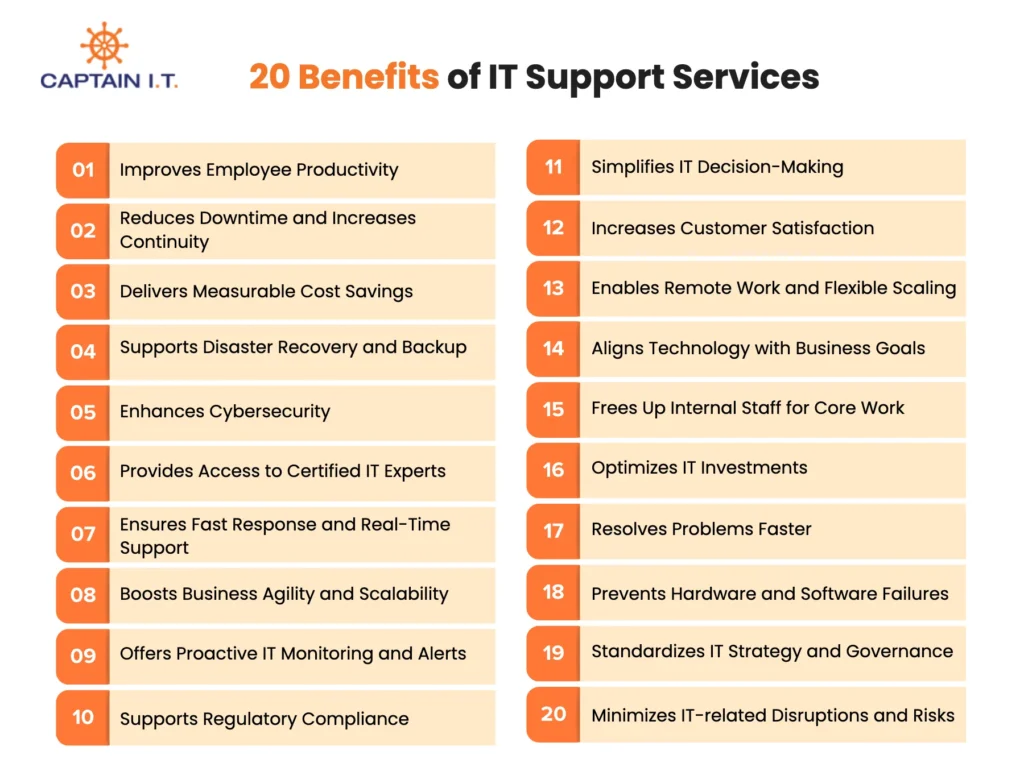
The 20 Benefits of IT Support Services are:
- Improves Employee Productivity: Reduces downtime and keeps employees focused on core tasks through fast technical support.
- Reduces Downtime and Increases Continuity: Prevents operational disruptions through proactive monitoring and recovery planning.
- Delivers Measurable Cost Savings: Controls technology expenses through predictable support costs and optimized infrastructure management.
- Supports Disaster Recovery and Backup: Protects business operations with automated backups and reliable recovery solutions.
- Enhances Cybersecurity: Secures business systems through firewalls, monitoring, MFA, and threat detection.
- Provides Access to Certified IT Experts: Gives businesses access to experienced professionals for infrastructure and security management.
- Ensures Fast Response and Real-Time Support: Resolves technical issues quickly through continuous monitoring and a help desk.
- Boosts Business Agility and Scalability: Supports infrastructure growth and operational flexibility through scalable cloud solutions.
- Offers Proactive IT Monitoring and Alerts: Detects technical risks early before they disrupt daily operations.
- Supports Regulatory Compliance: Helps businesses maintain compliance with HIPAA, GDPR, PCI DSS, and other regulatory requirements.
- Simplifies IT Decision-Making: Provides strategic technology guidance that aligns IT investments with business goals.
- Increases Customer Satisfaction: Maintains stable customer-facing systems and improves service reliability.
- Enables Remote Work and Flexible Scaling: Supports secure remote access and collaboration across distributed teams.
- Aligns Technology with Business Goals: Connects IT strategy with operational growth, productivity, and business performance.
- Frees Up Internal Staff for Core Work: Enables employees to focus on strategic responsibilities rather than technical troubleshooting.
- Optimizes IT Investments: Improves technology spending through infrastructure assessments and resource optimization.
- Resolves Problems Faster: Accelerates issue resolution through automated ticketing and remote diagnostics.
- Prevents Hardware and Software Failures: Reduces system failures through proactive maintenance and monitoring.
- Standardizes IT Strategy and Governance: Improves operational consistency through centralized policies and governance controls.
- Minimizes IT-related Disruptions and Risks: Reduces operational risks through proactive monitoring, change management, and incident planning.
Improves Employee Productivity
Employee productivity improves when IT support reduces downtime, resolves technical issues quickly, and maintains uninterrupted access to business-critical tools. When employees experience login failures, software crashes, or slow systems, their work slows down and output suffers. Managed IT support services resolve these disruptions through real-time monitoring, automated updates, patch management, centralized help desk support, and structured troubleshooting across devices, cloud platforms, and business applications. SMBs that use managed IT support services can experience up to 25% less idle time per employee due to faster issue resolution and improved system performance, according to Forrester.
Productivity also improves when collaboration tools such as Microsoft 365, Slack, and Google Workspace are properly supported by IT support teams. These platforms streamline communication and file sharing across departments, but they require ongoing maintenance, troubleshooting, and updates to function efficiently. IT teams ensure they remain stable, secure, and continuously updated without disrupting work hours. For instance, a law firm in Riverside saw a 40% reduction in internal IT tickets after transitioning to managed IT support, which scheduled updates outside peak times and provided direct technician access, helping staff maintain momentum throughout the day.
Reduces Downtime and Increases Continuity
By monitoring infrastructure in real time, resolving technical issues quickly, and maintaining structured recovery protocols, IT support reduces downtime and protects business continuity. Managed IT services continuously track server performance, network traffic, cloud environments, and endpoint devices to detect early warning signs such as hardware failures, bandwidth congestion, unauthorized access attempts, and abnormal system activity before they interrupt operations. Proactive maintenance, automated patch management, and real-time alerts help businesses maintain stable performance and reduce costly service interruptions. Gartner reports that proactive IT support practices can decrease unexpected IT outages by up to 45%, improving operational stability and employee productivity.
Business continuity also depends on reliable disaster recovery and backup planning supported by IT support services. Managed service providers (MSPs) use tools such as Veeam and Acronis to automate encrypted backups, replicate data across secure environments, and ensure systems are regularly monitored and maintained. IT support teams play a crucial role in managing these processes and maintaining recovery objectives for critical applications. For example, a Southern California manufacturing company avoided production delays during a server outage by switching operations to a standby environment within minutes, minimizing disruptions and maintaining operational efficiency.
Delivers Measurable Cost Savings
Managed IT support lowers operational costs by replacing unpredictable technology expenses with structured, fixed-rate services while improving how businesses manage hardware, software, and IT resources. Many SMBs overspend on emergency repairs, unused software licenses, duplicate tools, and outdated infrastructure due to reactive purchasing decisions. MSPs help reduce unnecessary spending by standardizing procurement, monitoring software usage, automating updates, and recommending lifecycle upgrades based on system performance and operational needs. For instance, migrating from on-premise servers to virtualized or cloud-based environments can reduce hardware investments, energy consumption, and maintenance costs.
Additional savings come from minimizing downtime and consolidating IT functions under a single IT support provider. Services such as outsourced help desk support, cloud management, cybersecurity monitoring, and endpoint maintenance are bundled into predictable monthly plans, improving budget control for small and mid-sized businesses. IT support teams also help optimize system usage and reduce inefficiencies through continuous monitoring and maintenance. A logistics company reduced annual IT expenses by 28% after replacing legacy infrastructure with managed IT services aligned to actual system usage. Regular performance reporting, asset tracking, and software license audits further help businesses maintain long-term cost efficiency while focusing investments on growth and innovation.
Supports Disaster Recovery and Backup
Critical systems can be restored more quickly after cyberattacks, hardware failures, or accidental data loss when IT support solutions include automated backups and disaster recovery planning. Automated data backup, cloud replication, ransomware protection, and disaster recovery planning are integrated into managed IT support environments to protect business operations during unexpected disruptions. Backup systems require routine testing and validation to ensure reliable recovery during outages, maintain secure offsite storage, and configure recovery objectives that minimize downtime and improve system availability. According to IBM, the average global cost of a data breach reached USD 4.4 million, highlighting how operational disruptions and delayed recovery can lead to major financial losses for businesses.
Tested backup recovery protects operational continuity and helps customers maintain confidence during outages or cyber incidents through effective IT support and disaster recovery planning. A healthcare clinic that loses access to its patient scheduling software during a ransomware incident relies on encrypted backups managed by IT support teams to quickly restore critical applications. Recovery planning reduces operational downtime and ensures systems are regularly tested and maintained, keeping critical business functions available during disruptions.
Enhances Cybersecurity
Cybersecurity has become a critical responsibility of modern IT support because businesses rely heavily on digital systems, cloud platforms, and connected networks for daily operations. For small and mid-sized companies, IT support teams deploy enterprise-grade firewalls, implement endpoint detection and response (EDR), and enable multi-factor authentication (MFA) to secure login access and reduce cyber risks. Encryption protocols protect sensitive data in transit and at rest, while automated patch management helps close known vulnerabilities quickly and efficiently.
IBM’s Cost of a Data Breach Report 2025 found that 97% of organizations that experienced AI-related security incidents lacked proper AI access controls, underscoring the importance of stronger cybersecurity management. IT support teams also monitor suspicious activity, conduct vulnerability assessments, and apply real-time threat detection to reduce the risk of ransomware, phishing, and unauthorized access. Strong cybersecurity support improves operational stability, protects sensitive business information, and strengthens customer trust. Proactive cybersecurity management also helps SMBs maintain compliance with industry regulations and reduce the financial impact of potential data breaches.
Provides Access to Certified IT Experts
Businesses improve operational efficiency when experienced IT support technicians manage technical infrastructure, cybersecurity, and system performance through structured support services. Managed IT support services provide access to specialists with credentials such as CompTIA A+, Cisco CCNA, and Microsoft Certified Solutions Expert, who demonstrate expertise in network management, cloud infrastructure, cybersecurity, and systems administration. These professionals monitor system performance, troubleshoot recurring technical problems, apply security updates, and manage infrastructure configurations that improve operational efficiency. Their technical knowledge helps businesses reduce downtime, maintain service continuity, and avoid costly configuration errors across business-critical environments.
Access to skilled IT support experts also improves long-term technology planning and infrastructure scalability. A healthcare provider migrating patient records to a cloud-based environment may require encrypted access controls, compliance-focused configurations, and uninterrupted system availability. IT support teams can securely manage deployments, reduce operational risks, and ensure systems are properly configured and monitored, helping maintain productivity throughout the migration process for growing organizations.
Ensures Fast Response and Real-Time Support
SMBs depend on fast IT support to maintain operational efficiency, prevent downtime, and keep customer-facing systems running without interruption. An MSP delivers this support through real-time monitoring, automated ticketing, centralized help desk services, and clearly defined service-level agreements, thereby improving response times during critical incidents. IT support teams continuously track network activity, cloud platforms, endpoint devices, and server performance to detect technical issues before they escalate into larger operational disruptions. Automated workflows also prioritize urgent support requests and route them directly to experienced technicians to resolve issues faster.
Fast issue response keeps employees productive, protects customer-facing systems, and reduces service interruptions during critical business hours. A retail SMB experiencing payment processing failures during peak shopping hours may lose transactions and customer trust if systems remain offline. With managed IT support from an MSP, technicians can troubleshoot issues remotely, quickly restore system functionality, and stabilize business operations before prolonged downtime disrupts daily revenue and employee workflows.
Boosts Business Agility and Scalability
Business agility and scalability improve when organizations receive reliable IT support that enables them to expand infrastructure, deploy applications faster, and adapt to changing operational demands without disrupting workflows. Flexible cloud infrastructure management supported by IT teams and scalable technology services allows businesses to grow operations smoothly, while centralized IT support enables them to scale users, applications, and storage without significant interruptions or costly hardware investments. Platforms such as Amazon Web Services and Microsoft Azure are often managed by IT support teams, enabling businesses to adjust computing resources based on workload requirements, improve efficiency, and reduce unnecessary operational costs.
Automation and modern infrastructure tools further strengthen scalability across growing business environments when guided by IT support expertise. Technologies such as Kubernetes support efficient application management across multiple environments, while Infrastructure as Code (IaC) helps standardize and accelerate system deployment under IT oversight. Managed IT providers also assist with cloud migration, cybersecurity management, workload optimization, and long-term infrastructure planning to support continuous growth. Capital One’s cloud-first AWS strategy shows how scalable infrastructure, when properly supported by IT services, can improve service delivery and operational agility. These scalable IT support solutions help businesses respond faster to market changes, improve customer experiences, and maintain long-term operational stability.
Offers Proactive IT Monitoring and Alerts
Managed IT support services offer proactive IT monitoring that helps SMBs detect warning signs early by continuously tracking servers, cloud platforms, endpoint devices, and network activity. IT support teams use network operations center (NOC) dashboards, endpoint telemetry, automated alerts, and monitoring tools such as SolarWinds, PRTG, and Nagios to identify unusual system behavior in real time. CPU usage, storage capacity, software performance, unauthorized access attempts, and network slowdowns are monitored continuously to detect early warning signs and prevent them from escalating into costly operational problems. This proactive IT support approach allows technicians to resolve technical issues early, maintain stable system performance, and reduce disruptions across business-critical environments and daily workflows.
Continuous monitoring through IT support also improves operational continuity and service reliability across fast-moving business environments. A logistics company relying on warehouse inventory systems may face rising server storage demands that could disrupt order processing and shipping operations. Through proactive IT support monitoring, automated alerts can detect storage issues early, allowing IT teams to allocate backup resources, optimize performance, and prevent downtime that could disrupt productivity and daily operations.
Supports Regulatory Compliance
Regulatory compliance becomes easier for SMBs when managed IT support services implement structured security controls, maintain secure access, and continuously monitor systems. IT support teams help businesses align their infrastructure with compliance frameworks such as HIPAA, PCI-DSS, and GDPR through encrypted data protection, role-based access controls, automated patch management, and detailed audit logging. Support teams also perform vulnerability assessments, monitor system activity, and maintain documentation that helps businesses identify compliance gaps before they become security or legal risks. These proactive IT support measures reduce the likelihood of data exposure, operational penalties, and regulatory violations across business-critical environments.
A healthcare provider handling patient records may need encrypted storage, monitored user access, secure authentication protocols, and documented system activity to satisfy HIPAA requirements. With ongoing support from IT teams or an MSP, the organization can maintain compliance through automated security updates, continuous monitoring, and controlled access management across medical systems and cloud platforms. These compliance-focused IT support services help businesses protect sensitive data, maintain operations, and reduce the risk of audits, penalties, and unauthorized access.
Simplifies IT Decision-Making
Strategic guidance from IT support professionals helps businesses make faster, more informed technology decisions that align with long-term goals. Managed IT support services assist SMBs by evaluating software platforms, cloud infrastructure, cybersecurity tools, and hardware investments based on scalability, compatibility, operational efficiency, and security requirements. IT support teams also conduct infrastructure assessments, compare vendors, manage technology roadmaps, and identify solutions that support current business operations without creating unnecessary costs or deployment delays. This structured decision-making process reduces uncertainty and helps businesses avoid unsupported systems, recurring technical issues, and inefficient technology investments.
Reliable IT support guidance also improves operational stability during infrastructure upgrades and digital transformation projects. A professional services firm implementing a cloud-based CRM platform may require secure integrations, remote accessibility, and workflow automation that support daily client management. With consultative support from IT teams or an MSP, the business can streamline deployment, maintain uninterrupted operations, and improve long-term technology performance while reducing implementation risks and operational disruption.
Increases Customer Satisfaction
Reliable IT support significantly enhances customer satisfaction by ensuring system stability, minimizing service interruptions, and enabling faster resolution of technical issues across customer-facing platforms. When essential services such as booking systems, customer portals, or support channels fail, the user experience deteriorates quickly, leading to frustration and dissatisfaction. IT teams help prevent these disruptions through proactive system monitoring, timely software updates, and well-defined incident response procedures that address issues before they affect end users. As a result, services remain consistently available, responsive, and dependable.
In addition, IT support infrastructure strengthens overall service delivery by optimizing CRM systems, automating key workflows, and maintaining high-performance applications. Efficient ticketing systems further improve customer experience by prioritizing requests based on urgency, allowing support teams to manage workloads more effectively and resolve critical issues sooner. For instance, Marriott International adopted NICE’s CXone Mpower to streamline its customer support operations, leading to faster response times and improved customer satisfaction. These backend improvements enhance the overall customer experience and strengthen loyalty and retention.
Enables Remote Work and Flexible Scaling
Through managed IT services, SMBs maintain secure remote access, stable communication, and uninterrupted collaboration across distributed work environments. IT support includes cloud infrastructure management, endpoint security, centralized device management, virtual private networks (VPNs), and single sign-on (SSO) configurations to help employees securely access business applications from different locations. Secure and scalable IT systems also enable businesses to adapt to evolving workforce demands while maintaining productivity in remote and hybrid environments. Remote connections, software updates, and cloud collaboration platforms require continuous monitoring to maintain secure access across distributed workforces.
Flexible scaling becomes easier when businesses can expand infrastructure resources without disrupting existing workflows. A growing e-commerce company hiring remote employees across multiple regions may require additional cloud storage, secure user access, and reliable communication tools to support daily operations. With managed IT support from an MSP, the business can onboard remote teams efficiently while maintaining operational continuity, system reliability, and secure access across all locations.
Aligns Technology with Business Goals
Strategic IT support services help SMBs align technology decisions with operational goals such as productivity, customer satisfaction, revenue growth, and long-term scalability. MSPs evaluate business processes, identify infrastructure gaps, and assess systems that limit operational efficiency or slow decision-making. IT support teams also help SMBs consolidate outdated platforms, improve cloud infrastructure, integrate business applications, and implement analytics tools that support measurable performance objectives. By aligning IT planning with business priorities and key performance indicators (KPIs), MSPs help organizations invest in technology solutions that support sustainable operational growth instead of short-term fixes.
Technology alignment also improves workflow efficiency and infrastructure performance across daily operations. IT support teams manage system configurations, automate repetitive tasks, and monitor performance metrics that impact service delivery and productivity. A retail company using cloud-based inventory management can leverage managed IT support to improve stock visibility, reduce fulfillment delays, and ensure accurate reporting across multiple locations. As a result, technology investments remain closely connected to operational performance and long-term business growth.
Frees Up Internal Staff for Core Work
By delegating technical responsibilities to a managed IT support provider, businesses allow internal teams to focus on high-value tasks rather than on recurring troubleshooting and system maintenance. Managed IT services help SMBs handle password resets, software updates, endpoint monitoring, remote diagnostics, patch management, and centralized help desk support, minimizing operational interruptions in daily workflows. IT support teams also resolve login failures, printer connectivity issues, application errors, and device configuration problems before they affect employee productivity or business operations. With fewer recurring technical interruptions, employees can stay focused on core work while daily workflows remain stable across departments.
Reducing internal IT workload also improves operational efficiency and employee productivity throughout growing businesses. A professional services company using managed IT support from an MSP can automate ticket workflows, accelerate issue resolution, and maintain uninterrupted access to business applications without overloading internal teams. This operational structure helps businesses strengthen productivity, improve workflow stability, and keep employees focused on strategic business objectives.
Optimizes IT Investments
IT support helps businesses maximize the value of technology investments by aligning infrastructure, software, and cloud resources with actual operational requirements. Many SMBs overspend on underused applications, outdated hardware, or unnecessary system upgrades due to limited visibility into infrastructure performance and usage patterns. Managed IT services address these inefficiencies through asset tracking, software audits, cloud monitoring, vendor evaluation, and infrastructure assessments, improving technology planning and purchasing decisions. MSPs also analyze workload demands, forecast capacity requirements, and recommend scalable solutions that support operational growth without increasing unnecessary technology costs.
Smarter investment planning through IT support also improves long-term infrastructure efficiency and financial control. A SaaS company operating cloud-based applications may experience rising monthly costs due to idle cloud resources and inconsistent server allocation. With support from an MSP and IT support teams, the business can optimize resource usage, remove unnecessary services, and maintain stable application performance while controlling operational expenses. As a result, businesses gain stronger cost control, more efficient resource use, and scalable IT support environments that support long-term growth.
Resolves Problems Faster
A structured IT support system helps businesses resolve technical issues faster by combining real-time monitoring, automated ticketing, and organized escalation workflows. When employees experience login failures, software crashes, email synchronization issues, or network connectivity problems, delayed support can disrupt productivity and affect customer service operations. Managed IT services help SMBs reduce these delays through centralized helpdesk platforms, remote diagnostics, automated alerts, and service-level agreement (SLA)-based response processes that prioritize issues by urgency and operational impact. IT support teams also monitor recurring incidents and identify root causes before they lead to larger system disruptions in business-critical environments.
Faster issue resolution directly improves operational continuity and employee efficiency. Support teams can remotely deploy patches, restore applications, reset credentials, and stabilize systems without waiting for on-site intervention. Automated ticket management and SLA-driven workflows have helped a multi-location retail company improve response coordination and reduce incident resolution delays. This structured approach helps maintain stable operations, limit downtime, and keep employees focused on core responsibilities without extended technical disruptions.
Prevents Hardware and Software Failures
Hardware and software failures become less frequent when IT support teams continuously monitor systems, maintain infrastructure, and address performance issues before they escalate into operational disruptions. Automated patch management, device health monitoring, firmware updates, and infrastructure assessments keep SMB technology environments stable before hardware or software issues escalate. IT support teams track server performance, storage capacity, network stability, and software behavior in real time to identify overheating devices, failing drives, outdated applications, or compatibility issues that can interrupt business operations. Automated alerts also allow technicians to respond quickly when systems exceed safe performance thresholds or require maintenance.
Preventive maintenance directly improves infrastructure reliability and extends equipment lifespan across business environments. IT support teams schedule updates, verify software compatibility, and standardize maintenance processes that reduce recurring technical issues and emergency repair costs. A utility provider that consolidated outdated software tools into a centralized support system improved operational efficiency and reduced recurring infrastructure disruptions across daily operations.
Standardizes IT Strategy and Governance
Consistent governance frameworks, centralized oversight, and standardized technology policies supported by IT support services help businesses maintain stable, predictable IT operations across diverse business environments. Managed IT support services help SMBs maintain a secure infrastructure through documented procedures, standardized system configurations, change management controls, compliance monitoring, and role-based access policies, improving operational consistency. IT support teams also manage centralized documentation, system change tracking, software standards, and risk monitoring, giving businesses clearer control over IT governance while reducing misaligned technology decisions and infrastructure instability. These IT support governance practices help businesses maintain predictable, scalable, and compliant IT environments across departments and remote operations.
Clear governance controls create stronger accountability and improve operational visibility across departments. IT support teams use governance, risk, and compliance platforms to monitor policy enforcement, maintain audit-ready records, and manage user permissions across business-critical systems. A financial services organization implementing centralized governance workflows improved audit preparation efficiency and strengthened policy consistency across multiple departments. This approach helps businesses reduce operational risks, maintain regulatory compliance, and support stable technology management.
Minimizes IT-related Disruptions and Risks
Operational disruptions become less frequent when IT support teams identify infrastructure issues, failed updates, and system vulnerabilities before they affect business operations. Unexpected outages, failed updates, and security vulnerabilities can disrupt daily operations and cause costly delays for growing businesses. Proactive IT support measures such as monitoring, automated patch management, change controls, incident response planning, and configuration tracking reduce IT-related risks for SMBs before they disrupt operations across business-critical environments. Continuous tracking of these elements by IT support teams helps detect risks early, ensuring system stability and uninterrupted availability while identifying vulnerabilities and performance issues before they escalate into larger operational failures or service interruptions.
During infrastructure changes, IT support strategies such as backup environments, staged deployment plans, and escalation workflows reduce the risk of service interruption. A logistics company migrating outdated systems to cloud infrastructure may require backup environments, staged deployment plans, and predefined escalation workflows to avoid service interruptions. MSP-led IT support planning provides the business with staged recovery paths, backup environments, and faster escalation routes to protect continuity during migration.
What Are the Benefits of Different Types of IT Support Services?
Outsourced and managed IT support improves scalability and cost control, while remote and onsite support improve issue resolution across distributed and physical environments. Proactive and 24/7 IT support helps prevent disruptions through continuous monitoring and faster response times, allowing businesses to maintain productivity, operational continuity, and long-term infrastructure stability.
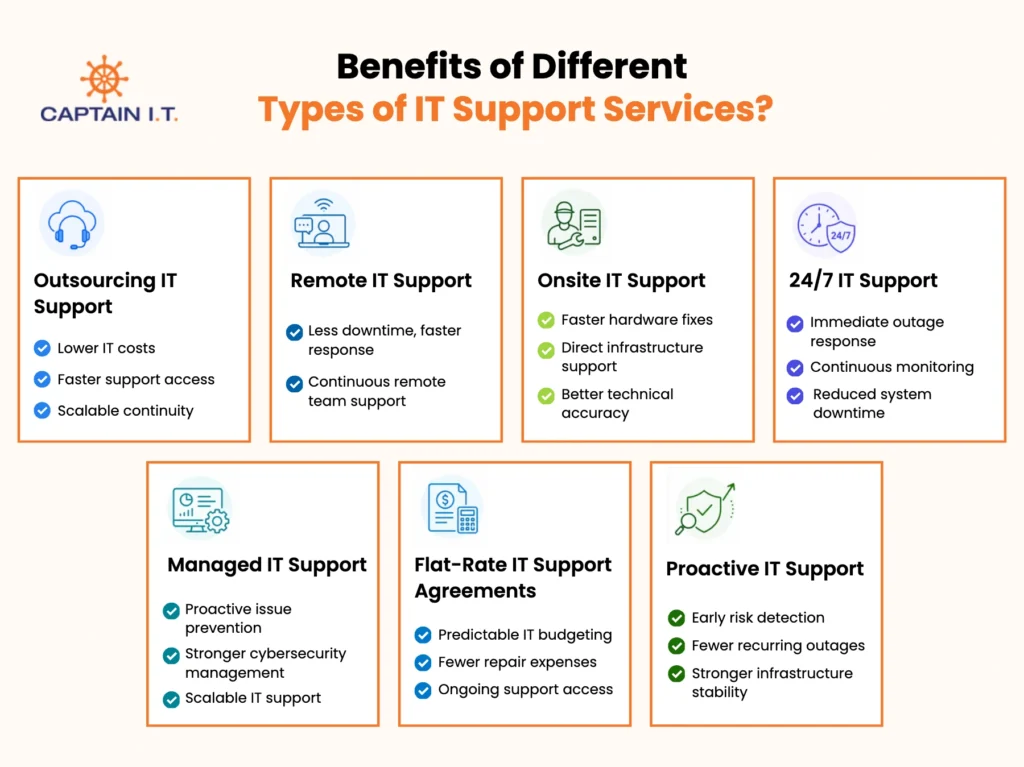
Outsourced and managed IT support improves scalability and cost control, while remote and onsite support improve issue resolution across distributed and physical environments. Proactive and 24/7 IT support helps prevent disruptions through continuous monitoring and faster response times, allowing businesses to maintain productivity, operational continuity, and long-term infrastructure stability.
What Are the Benefits of Outsourcing IT Support?
Outsourcing IT support lowers operational expenses by avoiding in-house hiring and training costs while providing businesses with access to specialized expertise, centralized monitoring, cybersecurity management, scalable help desk support, faster issue resolution, predictable maintenance costs, and a reduced workload for internal teams.
Key benefits of outsourcing IT support include:
- Lower staffing and infrastructure costs
- Faster issue resolution and support access
- Improved scalability and operational continuity
What Are the Benefits of Remote IT Support?
Remote IT support provides instant, secure access to technical experts who can troubleshoot and resolve software, hardware, and network issues from anywhere through remote diagnostics, centralized monitoring, cloud management, reduced downtime, faster response times, and continuous support for remote and hybrid work environments.
The following are key benefits of Remote IT Support:
- Reduced downtime and faster response times
- Continuous support for remote and hybrid teams
What Are the Benefits of Onsite IT Support?
On-site IT support provides immediate, hands-on assistance with physical hardware, complex network issues, and face-to-face employee training during infrastructure upgrades, equipment replacements, office relocations, and operational disruptions requiring direct technical expertise.
The primary benefits of on-site IT support are:
- Faster hardware troubleshooting and repairs
- Direct support for physical infrastructure issues
- Improved accuracy during complex technical work
What Are the Benefits of 24/7 IT Support?
24/7 IT support provides round-the-clock assistance to resolve technical issues and maintain system availability through continuous monitoring, emergency troubleshooting, automated escalation workflows, cybersecurity oversight, reduced downtime risks, and uninterrupted support for business-critical systems operating across different time zones.
The main benefits associated with 24/7 IT support include:
- Immediate response during outages and emergencies
- Continuous operational coverage and monitoring
- Reduced downtime across critical systems
What Are the Benefits of Managed IT Support?
Managed IT support provides businesses with proactive, outsourced technology management through continuous infrastructure monitoring, cybersecurity protection, cloud support, backup management, system maintenance, scalable infrastructure support, and long-term technology planning across centralized support environments.
Major benefits of managed IT support include:
- Proactive issue prevention and monitoring
- Improved cybersecurity and compliance management
- Scalable support for growing infrastructure needs
What Are the Benefits of Flat-Rate IT Support Agreements?
Flat-rate IT support agreements provide predictable monthly pricing for ongoing technical support, infrastructure management, monitoring, preventive maintenance, cybersecurity oversight, and continuous help desk services without unexpected repair expenses or fluctuating operational support costs.
Core benefits of flat-rate IT support include:
- Predictable monthly IT budgeting
- Reduced unexpected repair expenses
- Continuous access to support services
What Are the Benefits of Proactive IT Support Over Reactive Support?
Proactive IT support identifies and resolves technical issues before they disrupt business operations through continuous monitoring, preventive maintenance, automated alerts, scheduled updates, improved infrastructure stability, stronger cybersecurity protection, reduced downtime, and longer hardware lifespan compared to reactive support models.
Key benefits of proactive IT support include:
- Early detection of technical risks
- Reduced recurring disruptions and outages
- Improved long-term infrastructure stability
What Are the Benefits of IT Support for Different Types of Businesses?
Startups, remote businesses, and e-commerce organizations rely on IT support for cloud accessibility, secure communication, uninterrupted collaboration, payment security, and operational continuity that support long-term business growth and customer satisfaction. Across different business models, IT support helps maintain stable operations, reduce downtime, strengthen data protection, and improve overall infrastructure performance, aligned with operational and industry-specific requirements.
What Are the Benefits of IT Support for Small Businesses?
Small businesses benefit from IT support by gaining affordable access to cybersecurity, cloud management, technical troubleshooting, and infrastructure maintenance without having to build large in-house IT teams. Centralized support, proactive monitoring, automated updates, and faster issue resolution help SMBs reduce downtime, control operational costs, maintain secure business systems, and improve employee productivity while allowing teams to focus on customer service, sales, and daily operations.
Key benefits of IT support for small businesses include:
- Reduced downtime and faster issue resolution
- Improved cybersecurity and data protection
- Proactive system monitoring and maintenance
- Better cloud management and remote access
- Predictable IT costs and budget control
- Backup and disaster recovery support
- Access to experienced IT professionals
- Improved scalability and operational efficiency
- Compliance support and risk reduction
- Increased productivity and business continuity
What Are the Benefits of IT Support for Medium-Sized Businesses?
As medium-sized businesses expand operations, IT support helps manage the increasing complexity of infrastructure through scalable cloud environments, centralized monitoring, help desk management, and cybersecurity oversight. Growing organizations benefit from improved interdepartmental communication, stable infrastructure performance, stronger data protection, and reduced operational disruptions. Structured IT support also helps businesses maintain productivity, support workforce growth, and manage technology environments more efficiently across multiple operational functions.
9 Key benefits of IT support for medium-sized businesses include:
- Scalable cloud environments for growing infrastructure needs
- Centralized monitoring and help desk management
- Cybersecurity oversight and stronger data protection
- Improved interdepartmental communication
- Stable infrastructure performance
- Reduced operational disruptions
- Improved productivity and operational efficiency
- Support for workforce growth and expansion
- Efficient management of technology across multiple functions
What Are the Benefits of IT Support for Large Enterprises?
Large enterprises rely on IT support to maintain stable operations across multiple departments, locations, users, and complex infrastructure environments. Through centralized governance, network management, cybersecurity controls, compliance monitoring, and enterprise-level infrastructure maintenance, IT support helps reduce operational risks and improve large-scale system performance. Faster incident response, secure data management, and continuous infrastructure monitoring also help enterprises maintain business continuity and operational consistency across distributed business environments.
10 Core benefits of IT support for large enterprises include:
- Centralized governance across departments and locations
- Network management and cybersecurity controls
- Compliance monitoring and regulatory support
- Enterprise-level infrastructure maintenance
- Reduced operational risks
- Improved large-scale system performance
- Faster incident response and resolution
- Secure data management
- Continuous infrastructure monitoring
- Stronger business continuity and operational consistency
What Are the Benefits of IT Support for Startups?
For startups operating with limited internal resources, IT support provides scalable cloud infrastructure, cybersecurity protection, collaboration tools, and flexible technical management that support rapid business growth. Cloud-based systems, remote accessibility, automated maintenance, and secure infrastructure planning help startups reduce operational complexity and avoid costly infrastructure investments during early growth stages. These services allow startup teams to focus on product development, customer acquisition, and business expansion without recurring technical disruptions.
Top 10 benefits of IT support for startup businesses include:
- Scalable cloud infrastructure for rapid growth
- Cybersecurity protection for systems and data
- Collaboration tools for team communication
- Flexible technical management and support
- Cloud-based systems with remote accessibility
- Automated maintenance and updates
- Secure infrastructure planning
- Reduced operational complexity and costs
- Fewer technical disruptions
- Focus on product development and business expansion
What Are the Benefits of IT Support for Remote Businesses?
Remote businesses depend on IT support to maintain secure communication, uninterrupted collaboration, and stable cloud access across distributed workforce environments. Remote monitoring, endpoint security, centralized device management, and secure access controls help businesses maintain productivity while protecting systems and business data across multiple locations. Continuous technical support and remote troubleshooting also reduce downtime, improve operational continuity, and support reliable workflow management for hybrid and fully remote teams.
7 major advantages of IT support for remote teams are:
- Secure communication and collaboration across distributed teams
- Stable cloud access for remote work environments
- Remote monitoring and endpoint security protection
- Centralized device management and access control
- Continuous technical support and troubleshooting
- Reduced downtime and improved operational continuity
- Stronger productivity and workflow reliability
What Are the Benefits of IT Support for E-Commerce Businesses?
E-commerce businesses rely on IT support to maintain website availability, secure payment processing, stable server performance, and protect customer data during daily operations and high-traffic sales periods. Continuous monitoring, cloud hosting management, cybersecurity protection, and payment gateway maintenance help reduce downtime and prevent service disruptions that affect online transactions. Stable infrastructure performance and faster resolution of technical issues also improve customer trust, shopping experiences, and long-term operational continuity for online businesses.
9 key benefits of IT support for e-commerce businesses include:
- High website availability and stable server performance
- Secure payment processing and customer data protection
- Continuous monitoring and cloud hosting management
- Cybersecurity protection and threat prevention
- Reduced downtime during high-traffic sales periods
- Payment gateway maintenance and reliability
- Faster resolution of technical issues
- Improved customer trust and shopping experience
- Stronger operational continuity for online businesses
What Are the Benefits of IT Support for Various Types of Industry?
Healthcare providers, manufacturing companies, nonprofits, construction firms, property management companies, dental practices, and educational institutions all benefit from IT support based on their operational and compliance requirements. IT support helps these industries maintain secure infrastructure, stable communication, protected business data, and uninterrupted daily operations through cybersecurity management, infrastructure monitoring, cloud support, and proactive maintenance. Reliable IT systems also reduce downtime, improve operational continuity, and support efficient workflow management across complex industry environments.
What Are the Benefits of IT Support for Healthcare?
Healthcare providers benefit from IT support through secure patient data management, HIPAA compliance, reliable clinical systems, and reduced operational disruptions during patient care. Continuous monitoring, encrypted access controls, automated backups, and cybersecurity management help hospitals and clinics maintain stable electronic health record systems and secure communication platforms. Reliable IT infrastructure also improves operational continuity, protects sensitive medical information, and supports uninterrupted healthcare services across clinical environments.
The top 7 benefits of IT support for healthcare providers are:
- Secure patient data management and protection of sensitive health records
- HIPAA-compliant systems and regulatory support
- Reliable clinical and hospital IT systems for smooth operations
- Reduced downtime and fewer disruptions during patient care
- Continuous system monitoring for early issue detection and prevention
- Strong cybersecurity protection against data breaches and cyber threats
- Automated backups and secure recovery of critical medical information
What Are the Benefits of IT Support for Manufacturing?
Production environments operate more efficiently when IT support maintains network stability, monitors connected equipment, and prevents system failures that interrupt manufacturing workflows. Industrial network monitoring, infrastructure maintenance, rapid troubleshooting, and cybersecurity protection help manufacturers maintain supply chain coordination and stable production output. Strong IT support also reduces operational delays, improves communication between facilities, and supports continuous manufacturing operations across complex production environments.
Below are the 9 benefits of IT support for the manufacturing sector:
- Improved production efficiency and operational performance
- Stable network connectivity and system reliability
- Continuous monitoring of industrial equipment and systems
- Reduced downtime through rapid troubleshooting and support
- Strong cybersecurity protection for manufacturing systems
- Better supply chain coordination and communication
- Prevention of system failures that disrupt production workflows
- Enhanced communication between plants and facilities
- Increased overall productivity and operational continuity
What Are the Benefits of IT Support for Nonprofits?
Nonprofit organizations benefit from IT support by improving secure communication, protecting donor information, and maintaining stable operations with limited internal technology resources. Cloud collaboration platforms, automated maintenance, remote technical assistance, and cybersecurity protection help nonprofits reduce operational complexity while supporting fundraising activities and community programs. Reliable infrastructure management also improves workflow efficiency and allows nonprofit teams to focus more resources on outreach initiatives instead of recurring technical issues.
The top 9 benefits of IT support for nonprofit organizations are:
- Secure communication systems for staff and stakeholders
- Protection of donor and sensitive organizational data
- Stable and reliable IT infrastructure with minimal downtime
- Cost-effective technology management with limited resources
- Cloud collaboration tools for remote and distributed teams
- Cybersecurity protection against data breaches and threats
- Automated maintenance and updates to reduce technical workload
- Remote IT support for quick issue resolution
- Improved operational efficiency for fundraising and outreach activities
What Are the Benefits of IT Support for Construction?
Secure communication, stable project coordination, and uninterrupted access to cloud-based project data are key benefits of IT support for construction companies operating across field and office environments. Mobile device management, remote access support, cybersecurity controls, and infrastructure monitoring help construction firms maintain workflow continuity between contractors, project managers, suppliers, and operational teams. Stable IT systems also reduce delays caused by communication failures and improve coordination across multiple construction locations.
9 major advantages of IT support in the construction industry are:
- Secure communication between field teams, contractors, and office staff
- Stable access to cloud-based project data and documents
- Improved project coordination and workflow management
- Mobile device management for on-site operations
- Remote access support for teams working across multiple locations
- Strong cybersecurity protection for project and company data
- Continuous infrastructure monitoring to prevent system issues
- Reduced delays caused by communication or technical failures
- Better coordination across multiple construction sites and teams
What Are the Benefits of IT Support for Property Managers?
IT support helps property management companies maintain tenant communication, secure operational databases, reduce system downtime, and improve daily property management operations across multiple locations. Centralized infrastructure management, software maintenance, remote access support, and continuous monitoring help property managers maintain stable communication with tenants, maintenance teams, and vendors. Strong IT support also improves operational visibility, protects tenant information, and supports reliable management of distributed residential and commercial properties.
The 9 key benefits of IT support for property managers are:
- Improved tenant communication and support systems
- Secure storage and management of tenant and property data
- Reduced system downtime and improved operational continuity
- Centralized IT infrastructure management across properties
- Remote access support for managers and maintenance teams
- Continuous system monitoring for early issue detection
- Strong data security and protection of sensitive tenant information
- Better coordination with vendors, tenants, and maintenance staff
- Improved efficiency in managing multiple residential and commercial properties
What Are the Benefits of IT Support for Dental Practices?
Dental practices benefit from IT support through reliable scheduling systems, secure patient records, stable imaging software, and HIPAA-compliant clinical environments. Automated updates, cybersecurity protection, secure backups, and infrastructure maintenance help reduce technical disruptions that affect patient appointments and treatment workflows. Stable technology environments also improve appointment coordination, support uninterrupted dental services, and protect confidential patient information across clinical and administrative systems.
Top 9 benefits of IT support in dental healthcare include:
- Reliable appointment scheduling systems
- Secure patient record management
- Stable dental imaging and diagnostic software
- Compliance support for healthcare data regulations
- Reduced technical disruptions during patient care
- Strong cybersecurity protection for sensitive patient information
- Automated updates, backups, and system maintenance
- Improved workflow efficiency in clinical and administrative operations
- Enhanced continuity of uninterrupted dental services
What Are the Benefits of IT Support for Education Institutions?
IT support helps educational institutions maintain secure learning platforms, stable network access, protected student data, and uninterrupted digital learning environments across academic departments. Continuous monitoring, infrastructure maintenance, cybersecurity management, and remote access support help schools maintain reliable communication between students, faculty, and administrators. Stable IT systems also improve the accessibility of online learning, protect institutional information, and support consistent academic and administrative operations across classrooms and remote learning environments.
The 9 benefits of IT support for educational institutions are:
- Secure digital learning platforms and systems
- Stable and reliable network connectivity
- Protection of student, staff, and institutional data
- Continuous system monitoring and maintenance
- Strong cybersecurity protection against threats
- Remote learning and collaboration support tools
- Improved communication between students, teachers, and administrators
- Reduced downtime and fewer disruptions to learning
- Enhanced efficiency in academic and administrative operations
How to Maximize the Benefits of IT Support for Your Business?
To maximize the benefits of IT support for your business, you should take a proactive, structured approach to managing your technology environment rather than waiting for technical problems to disrupt operations. Focus on maintaining secure systems, monitoring infrastructure continuously, updating software regularly, and aligning IT decisions with long-term business goals. Businesses that actively manage their IT environments are better positioned to reduce downtime, improve cybersecurity, maintain operational continuity, and support scalable business growth.
Follow these 9 best practices to improve the value of IT support for your business:
- Use proactive monitoring to detect and resolve issues early
- Maintain regular software updates and cybersecurity protection
- Implement automated backups and disaster recovery plans
- Standardize IT systems, processes, and infrastructure management
- Train employees on cybersecurity awareness and secure technology usage
- Optimize cloud platforms and remote access environments
- Monitor system performance and address operational risks quickly
- Align technology investments with operational and business goals
- Partner with a reliable provider offering scalable IT support services
Following these practices helps businesses maintain stable operations, strengthen security, improve productivity, and maximize long-term technology performance. A well-managed IT environment also allows businesses to respond more efficiently to operational changes, support scalable growth, and maintain consistent performance across daily business operations.